In 2026, nonprofits are facing increasing pressure to demonstrate impact and clearly communicate how their work makes a difference. An annual report is your organization’s opportunity to reflect on what you’ve accomplished, stay accountable to your community, and create meaningful connections between your mission, your impact, and the people who make your work possible. More than a list of achievements, it should tell the story of your impact and inspire confidence in the work ahead.
Over the past several years, we’ve compiled annual reports and impact reports that highlight what great nonprofit storytelling looks like in practice. And now, as many organizations navigate tighter budgets, smaller teams, shifting priorities, and growing demands for transparency, the need for a strong annual report is greater than ever.
The reports included in this recap caught our attention for different reasons. Some use immersive digital storytelling and interactive design. Others take a simpler, more traditional approach that’s clear and impactful. There’s no single formula for creating an effective annual report. Together, these examples (listed in alphabetical order) offer inspiration and ideas for nonprofits looking to strengthen their own annual reporting in the year ahead.
8 Great Examples to Inspire Your Nonprofit Annual Report
Code for America 2025 Impact Report: Built for This
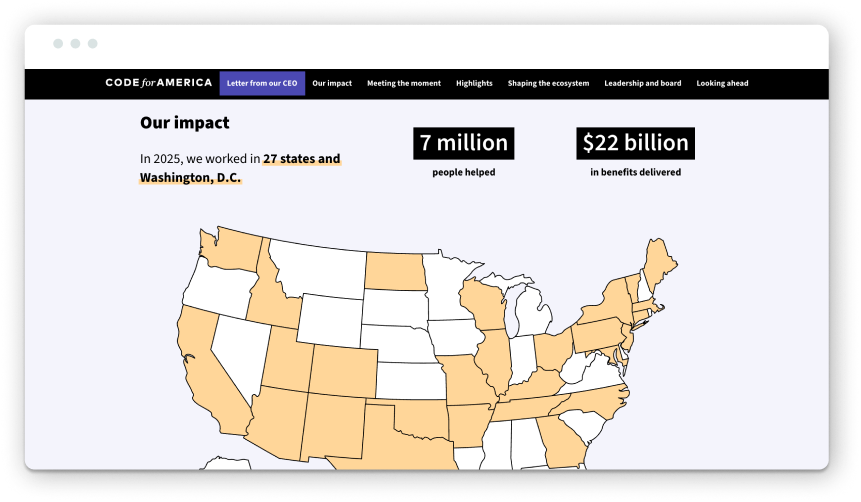
We featured Code for America in last year’s roundup, and we’re including them again for good reason! Year over year, the organization creates annual reports that feel deeply connected to its brand, mission, and the realities of the current moment.
This year’s report opens with a simple, yet powerful statement: Built for This. The message is reinforced in CEO Amanda Renteria’s opening letter: “In 2025, we didn’t step back. We built. We adapted. We helped states respond in real time.” From the start, the report acknowledges the complex landscape nonprofits operate within, from shifting political priorities to rapid technological change, while making a clear case for why its work matters more than ever for the people it serves.
From a visual standpoint, the report is Code for America-branded. Vibrant colors, clean design, and subtle motion guide and engage users throughout the reading experience without being too distracting. The top-level navigation makes it easy to jump between sections and explore topics based on your interest rather than forcing you to read linearly. Of course, we’d expect the report’s UX to be spot-on, given that it comes from a civic tech design org.
What stood out in this report is how CFA addresses the elephant in the room: AI. It outlines how it uses AI responsibly to improve government services and expand access, while staying transparent about its approach and true to its mission.
Through all the change and challenges, the report closes on an optimistic note, reinforcing the idea that in times of uncertainty, organizations can still make meaningful progress. It’s a strong example of how an annual report can simultaneously acknowledge challenges, celebrate successes, and inspire confidence in what comes next.
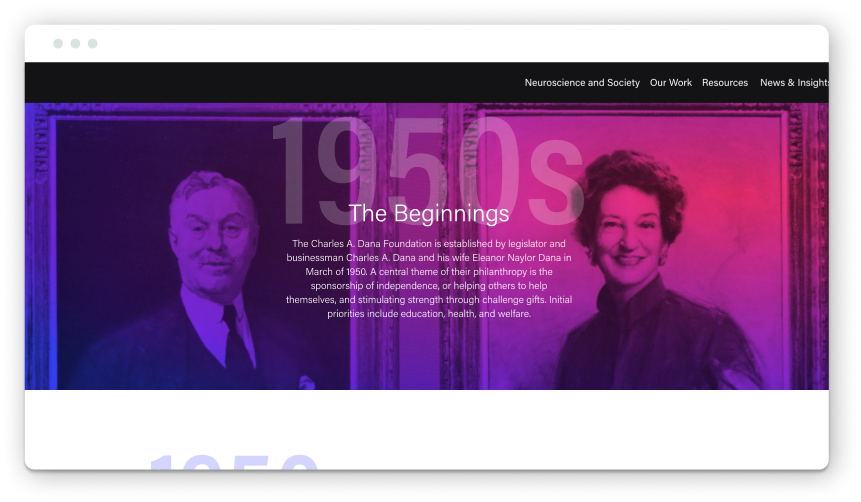
While this isn’t technically an annual report, this example from Dana Foundation showcases how organizations can celebrate milestones through digital storytelling. As your organization reaches a major anniversary, an annual report may not provide enough space to fully convey how much you’ve accomplished. If this is the case, you can consider creating an interactive timeline or web page like Dana’s to tell the bigger story of your legacy and impact.
To mark the Dana Foundation’s 75th anniversary, our team partnered with Dana to create an interactive timeline exploring its history and contributions to neuroscience over the past seven decades. Rather than presenting history as a long list of milestones, the landing page organizes content by decade, allowing readers to explore different eras of its work. In doing so, this effectively visualizes just how long Dana has been making an impact within the community.
Content and text are organized so each milestone is front and center on your screen, with the year the milestone took place nicely animating into the background for context and visual interest. The experience also highlights the Dana Foundation’s rich photographic archive, using historical imagery to bring key moments and achievements to life.
The timeline organizes a significant amount of historical content in an engaging format. For organizations approaching a major anniversary, this example highlights the value of looking beyond a single year-in-review to showcase lasting impact.
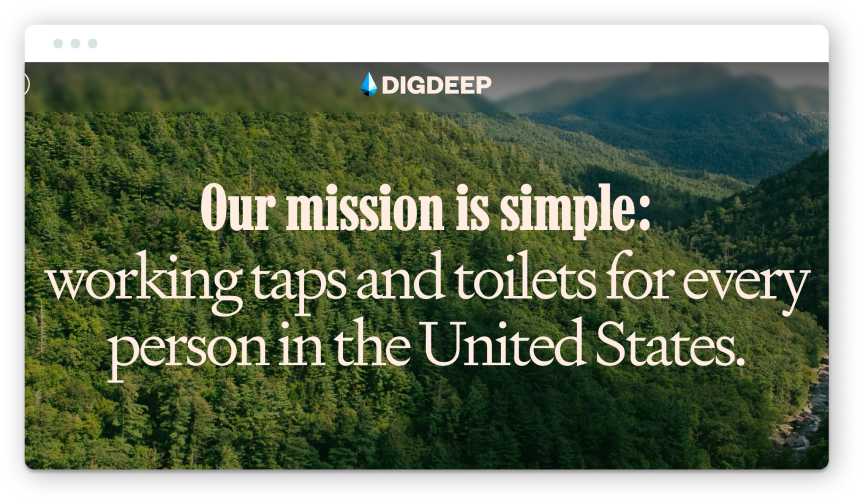
DigDeep’s annual report is a powerful reminder that impact data becomes far more meaningful when it’s paired with compelling visual and community-based storytelling. Imagine this same content presented as a static PDF filled with dense walls of text and confusing charts … it would certainly be less impactful. Through immersive video, photography, and thoughtful storytelling, DigDeep creates an experience that invites readers in to learn more about its mission and connect more deeply (no pun intended).
As we’ve said, the report’s visual identity is strong. Bold color, typography, photos, and video pack a punch. As you move through the report, it’s almost like you’re transported to the communities and project sites where the work is happening, making the impact feel real and tangible.
From a content strategy perspective, we appreciate that the report is broken down into sections based on their impact model: Advance Community-Led Solutions, Develop an Evidence Base, Mobilize America, and Build an Ecosystem of Change. These unique sections ground the impact outlined in the report in the organization’s broader strategy for systems change.
Another small detail we appreciate is that the letter from the CEO is available in both written and audio formats, with the CEO reading the message himself. It adds a bit more personality and humanity to the report. They even designed their financials section to be both engaging and transparent. We usually see financial data added at the end of reports, buried in plain text to be glossed over. All in all, this example absolutely delivers on immersive annual reporting.
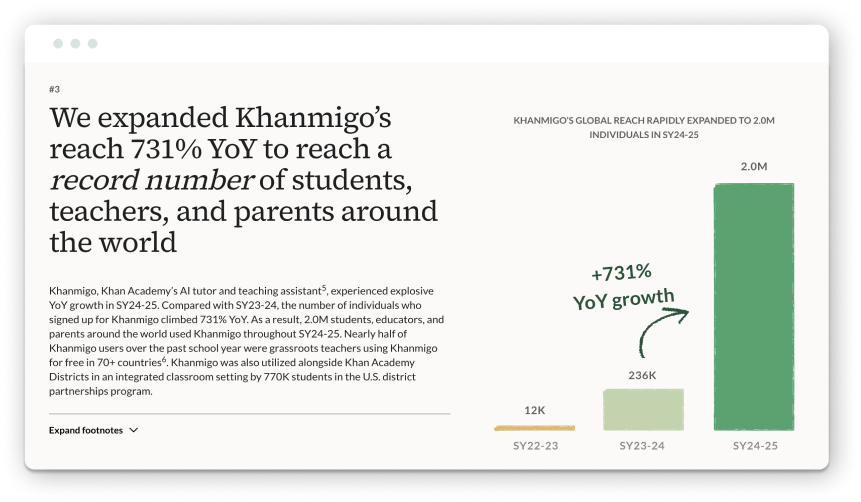
This statement opens Khan Academy’s 2024-2025 report and immediately establishes its aspirational tone. From there, the report delivers a polished experience that’s aligned with its brand: credible and grounded in the belief that learning should be accessible and engaging.
What makes this report stand out is its more traditional approach to annual reporting. Not every organization needs a highly interactive microsite or immersive storytelling experience. For many nonprofits, a clear, well-structured report that prioritizes impact, outcomes, and key takeaways is exactly what you need! Khan Academy demonstrates how this approach is effective when it’s paired with strong branding and thoughtful content design.
The report’s design does a nice job of balancing professionalism and playfulness. We enjoy the design touches like hand-drawn chart treatments, pencil underlining, and other subtle illustrated elements that are rooted in education but still appear polished. Photography also plays an important role in this report. Images of students and educators in the classroom help connect the organization’s work to tangible, real-world outcomes.
The report also succeeds in communicating impact through a series of 7 declarative statements. Numbered highlights throughout the report make key achievements easy to scan at a glance. The report ends on one word: Onward! It’s simple, but effective. This aspirational tone is fitting for an upbeat education organization that works with students. Overall, this gives readers a feeling of momentum and possibility of what’s to come.
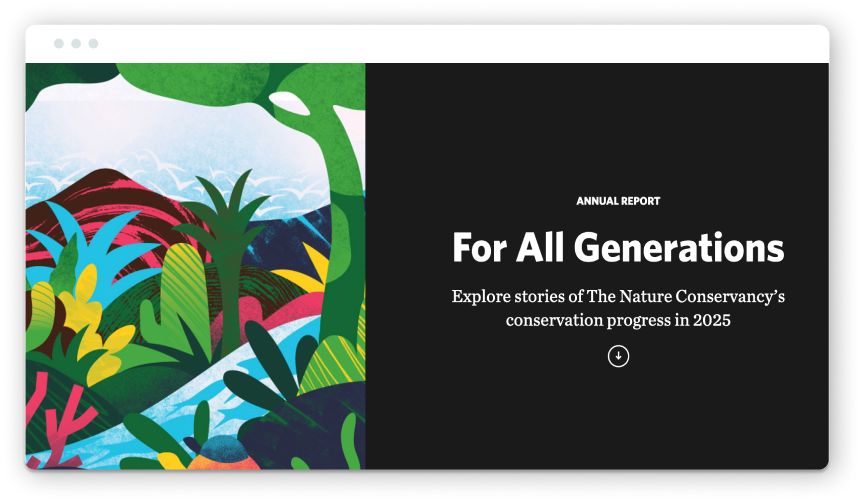
The Nature Conservancy Annual Report: For All Generations
As environmental organizations continue to work within an impossible landscape, The Nature Conservancy’s 2025 annual report shows how to communicate large-scale impact on large-scale issues concisely without overwhelming readers. The overall UX is clean, easy to navigate, and offers ways for audiences to engage in deeper levels depending on their interest.
One of the report’s standout features is its interactive conservation map, which allows users to explore conservation stories around the world through location-based snapshots. The report also features a carousel component that highlights moments that stood out most in 2025, including New York’s largest climate investment and $1 billion for TNC’s Nature Bonds Program.
We appreciate the report’s approach to audience engagement, which offers it in both digital and PDF formats. While a downloadable PDF is available for readers who want additional detail, the core content lives directly on the website, making it more discoverable, searchable, and easier to engage with. PDF downloads are also offered in multiple languages, helping connect international audiences to its work.
This is also one of the few reports we explored that includes a clear call to action (CTA) for readers to subscribe to their newsletter, which is a great opportunity to capture folks interested in learning more about what you do.
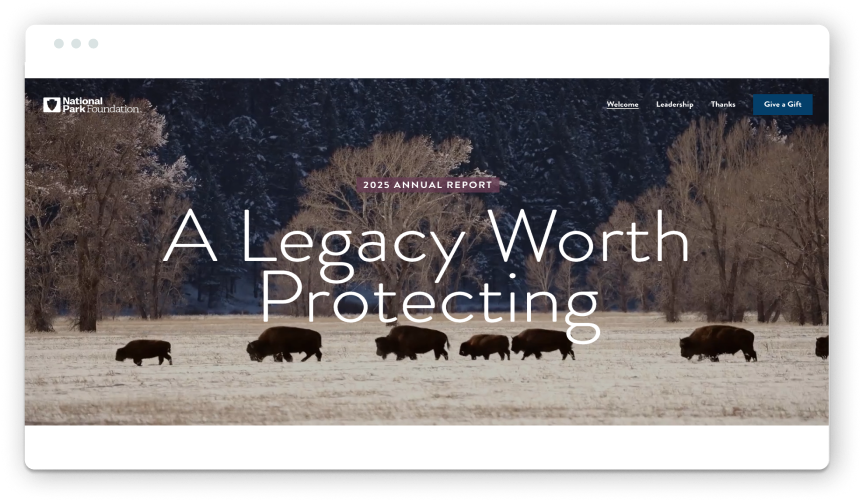
National Park Foundation 2025 Annual Report: A Legacy Worth Protecting
This year was especially trying for the National Park Service and the National Park Foundation, with conversations around funding, staffing, and the future of America’s public lands. Despite this, the Foundation’s annual report makes a compelling case for why our parks matter and are worth protecting.
The report begins with a small but memorable detail: a loading screen that serves as a welcome before readers enter the report. Once the screen has loaded, the first thing you see is a cinematic video showcasing the diversity of America’s parks, from sand dunes to the Lincoln Memorial.
Again, it’s no surprise that photography and videography are crucial to this report’s impact, given the nature of their work. The imagery creates an emotional connection that reinforces the importance of protecting the land and natural beauty. Subtle motion and bold stats guide readers on the journey, with carousels allowing them to dive deeper if they’re interested in the topic.
When the future of support for national parks feels increasingly uncertain, the report serves as a powerful reminder of what’s at stake.
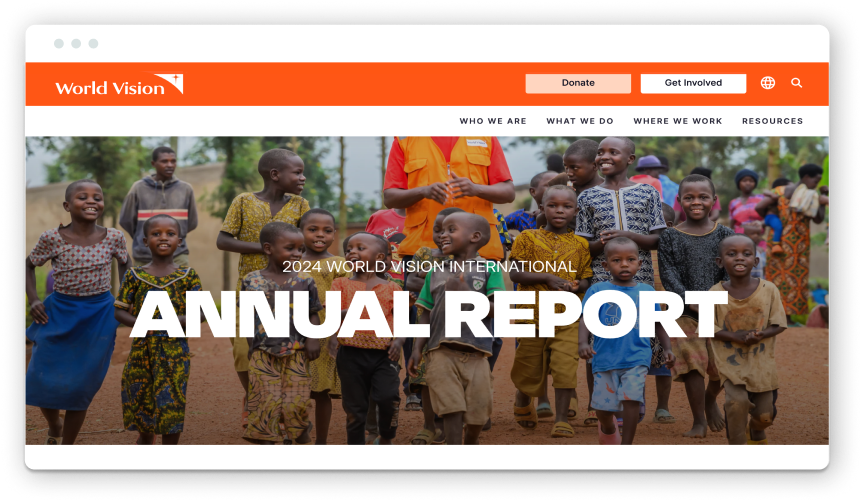
World Vision’s 2024 annual report is a masterclass in immersive storytelling. From the moment you start scrolling, full-screen imagery transitions through a simple sequence: “We. Are. World Vision.” before introducing the statement: “Our work reaches children no matter their background or where they live.” It’s an effective opening that quickly communicates its scale and commitment.
The report helps readers understand the breadth and depth of their work. Rather than assuming audiences are already familiar with the organization, it provides pathways to explore its global strategy and long-term goals. A world map further reinforces the organization’s reach, helping audiences visualize the communities and regions where World Vision is working. Key sections focused on global impact, emergency response efforts, and the We Are Global campaign create a cohesive narrative about what it means to operate as a truly international organization.
One suggestion for improvement would be better report navigation. While the scrolling experience is engaging at first, the report covers a significant amount of content, and it starts to get tiring after a while. A table of contents or jump navigation would make it easier for readers to explore specific topics without having to scroll back and forth through the whole experience.
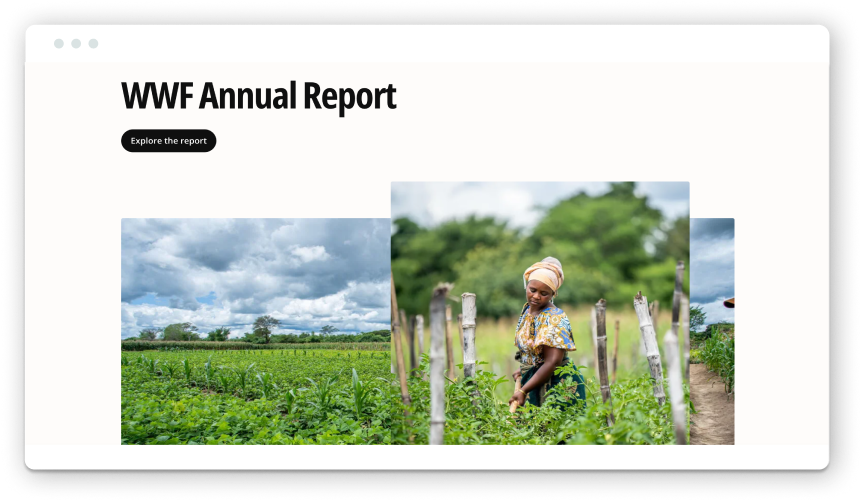
While we generally recommend publishing annual reports as HTML pages on your website to improve accessibility and SEO performance, WWF’s 2025 report proves that strong storytelling can still shine through a more traditional pamphlet-style report. Instead of just linking to the report, they support it with a dedicated landing page that provides context and highlights past reports.
A standout feature of this report is its storytelling. A recurring map-pin graphic helps ground stories in specific locations, reinforcing both the local and global scale of the organization’s impact. Readers gain a clearer understanding of how conservation efforts connect across regions, ecosystems, and communities worldwide. The report also does a really nice job of balancing narrative and data. Bold stats stand out at a glance, while focused themes and stories on each page create a clear structure that keeps readers engaged.
One statement captures the sense of urgency and purpose: “Nature provides everything that makes our lives possible. And this year, perhaps more than ever, nature needs us now.” WWF builds on that messaging by outlining 2025 Insights: Progress Toward a More Sustainable Planet. By connecting annual accomplishments to broader environmental trends and goals, the report helps readers understand what they accomplished and why it matters in the larger conservation context.
And if you want to explore the potential of building a great report for your organization, reach out anytime to work together. Maybe your report will make this list next year!
Kaylee Gardner, Senior Digital Strategist at Constructive, contributed to this roundup!
Your website represents many things. For some nonprofits, it’s a place where your communities can gather. For others, it may be a main driver of donations or a knowledge hub that stores the wealth of information you develop and share. But for all nonprofits (and for-profit companies too), your website is also arguably your most important brand experience.
What exactly makes a website a “brand experience”? The decisions you make to build your website visually and functionally may not always feel like brand decisions, but they are (or should be). Every website choice should extend from brand, creating a web-based “brand experience” that your audiences will ultimately remember you by. A nonprofit that aims to emphasize its people-centered approach in its brand strategy should elevate testimonials, people-focused photography, and accessible language throughout its website. A nonprofit looking to differentiate its brand as a thought leader in its space should have a robust resource center with advanced filtering and functionality. If you’re a data-driven organization, your website should feature data visualizations. I could go on, but you get the point.
The importance of this approach has long been understood by organizations, especially nonprofits, who want their online presence to match the intention, values, and often also the vibrancy of who they are and why they exist. But with recent developments in AI-powered search and general uncertainty about what the future of the search and website landscape will look like, it’s easy to get caught up in a sea of distracting recommendations on where to place your resources. I hope to reinforce why, even in the age of AI, brands will reign supreme.
What is AI Doing to Search and Websites?
In August 2025, an article appeared in New York Magazine titled “SEO is Dead. Say Hello to GEO,” with GEO being a new and slightly flashy acronym for “generative engine optimization.” This article was just one of the many news articles, opinion pieces, forum posts, and webinars that have emerged over the past two years proclaiming that search will never be the same (many with similar titles claiming SEO is dead). LLMs like ChatGPT have skyrocketed to success, changing user search habits and forcing giants like Google to pivot. Google has tried to keep up, mostly through expanding its AI overviews and eventually launching a full AI search mode. Google has arguably even fallen behind Bing, whose early partnerships have turned into the now Copilot search experience in Bing.
The questions our clients have begun asking me, as our team’s SEO expert, have also changed. No longer do marketing and digital teams want to know how to rank in Google; they want to know how to rank in ChatGPT. What are the AI crawlers looking for on their website? Is it even worth it to pick keywords and fill out SEO metadata in the Yoast SEO plugin anymore? Should they change their content strategy, their marketing strategy, or their business development strategy to adapt?
One of the most recent and worrying developments is a patent that Google filed and was recently granted, which could replace website landing pages with personalized AI-generated landing pages. In a Forbes article responding to the patent’s acceptance, the author even went as far as to say:
“Your job is no longer to build a destination. It’s to build a parts library. And one that’s well documented so that when an AI agent reassembles those parts for the human on the other side, the parts are put together in a way you wish to be represented.”
To reel us in, just because this patent was granted does not mean Google will move forward with it. There’s no need to panic now, but there’s good reason to stay updated and start building a more future-proof approach to your online visibility. This is where brand still applies.
Why Should You Focus on Brand Right Now?
But how does your brand apply? Well, currently, your brand plays a big part in surfacing your content across AI-driven search tools. And, in my opinion, the real people who also appreciate a brand experience still matter, too. Your brand just might be powerful enough to bridge this gap between building for large language models and building for humans.
Appeasing AI: Brand Mentions and Recognition
At their simplest, large language models like ChatGPT train on massive datasets, using neural networks to understand relationships among content so they can return answers most likely to be useful to a user. Part of understanding what will be most helpful to a user involves examining how often a brand is mentioned in its training data set. This means the more brand mentions your organization has across the internet, the more likely your content is to be included in a ChatGPT response. This SEO principle has always existed, but in a slightly different form: website backlinks.
Similarly, traditional search engines have used backlinks for years to establish a website’s relevance and the context of other websites and content it exists within, in order to organize and rank results. Brand mentions and backlinks are, at their core, very similar, but now the actual links matter less, and the brand name matters more. If anything, this is the time for your organization to increase investment in marketing activities that boost your brand recognition and relevance online. And all of these efforts must start with a strong, well-branded website.
Another interesting phenomenon is query rewriting. LLMs will often rewrite user queries to make data retrieval easier or to provide more personalized results. In a study completed by Trakkr.ai, an AI visibility tool, they discovered what they deemed “phantom competitors.” The study goes on to explain:
When you ask, “What’s the best email marketing tool?” AI doesn’t just find answers — it inserts brand names you never mentioned. Your search for “email marketing software” becomes “Mailchimp vs. Klaviyo email marketing comparison.”
This happens in over 1 in 10 queries. AI’s training on comparison content leads it to assume brand-specific searches — even when you ask a generic question. To repeat, in over 1 in 10 sampled queries, the AI tool determined and added brand names, yielding results from the chosen brands without the user’s knowledge. If this is going to take place, you want to try to secure your brand’s spot as a phantom competitor itself.
These are only some of the ways your brand helps determine whether you show up in generative search engines, but together they drive home that this is not a time to de-emphasize or ignore brand. And if we’re lucky, the resources we dedicate to marketing and branding can yield positive results for the humans we serve as well.
Appeasing Real People: Brand Expression and Authenticity
I am a real believer that we must still build our websites for humans. It’s true that in order to reach those humans, we must now contend with ChatGPT’s crawlers and result choices. But at the end of the day, we are hoping those results end up in the hands of real humans. This is yet another reason why brands may be more important now than ever.
In a world where organizations at large are leveraging AI-generated content and AI-powered chatbots, among other AI-driven experiences on their websites, your humanity can set you apart. I, for one, am experiencing real fatigue reading AI-generated results and content. I am becoming tired of trying to assess if what I’m reading was written by and meant for a real human. And I’m not the only one.
As I stated in the opening of this article, your organization’s website is arguably your most important brand experience. It’s a place where your stakeholders go to explore your information and understand your organization’s unique perspective and value. As everything else on the internet begins to flatten as it’s run through LLMs, your website will only become more distinctive if it continues to feature human-oriented content, an intuitive user experience, and a striking visual design. And this rings even more true for impact-driven organizations. Nonprofits are held to a higher standard when it comes to expressing their brand’s vision, mission, and how they show up in the world authentically.
If we return to Google’s scary patent, it only drives home the importance of brand expression on your website. As the article’s author said, in a future where Google is generating AI landing pages from your website, you need to build your website so that “when an AI agent reassembles those parts for the human on the other side, the parts are put together in a way you wish to be represented.”
This suggests that now more than ever, it’s important for every single module on your website to be highly branded and uniform, so any newly created iteration of your information remains both unique to your organization and consistent with your brand strategy. Your intention as you build your website will have to be even stronger as you lose more and more control over how end users experience it. You’re still trying to reach that human on the other side.
So, What Should You Do?
As is clear, the search landscape is still changing. It now feels like not even days or weeks can go by without new or updated products, and a slew of experts sending mixed messages about how your organization should react. This remains difficult to parse, but one thing is for sure: it’s time to take your brand seriously.
For some nonprofits that already have a strong brand, this may mean increasing marketing efforts across the internet to increase brand mentions and recognition. For other nonprofits, it may be time to reassess your brand strategy and how your website expresses it, to strengthen your presence at a time when it’s crucial.If this is your case, contact us to discuss what this could look like.
Even in the age of AI, who you are and why you exist still matter. So, let your brand bridge the gap between AI and humans.
At Constructive, our work has grown in both scope and complexity, with multi-disciplinary teams collaborating across strategy, branding, design, and technology to support mission-driven organizations. As our agency evolves, so does the importance of strategic leadership to guide not just projects, but people, culture, and long-term vision.
For years, Andrea has been at the center of this work. Her leadership has helped shape how we make decisions, helping us understand the bigger picture of running and working in an agency and the impact each decision has on the rest of the team. Now, she’s stepping into a new role as Managing Director to lead Constructive into its second act.
We sat down with Andrea to talk about her leadership philosophy, balancing structure and creativity, and what she’s most excited to build in this next chapter.
How would you describe your approach to leadership?
I’d like to think that my approach is based on a combination of transformational and practical leadership. My goal is to always help give the team the space to explore and become the best versions of themselves, but I recognize that in the here and now, structured processes help us achieve immediate, tangible goals.
Constructive often works on complex, multi-disciplinary projects. What does it take to keep these moving forward smoothly?
I’ll tell you what—in an ideal situation—I think it takes. First, clarity. From the outset, we need a shared understanding of goals, scope, timelines, and decision-making. Second is communication. It must be clear and consistent, especially in a remote work environment. I am a firm believer that we should err on the side of overcommunication. Third is mutual respect and trust. When there’s mutual respect, space for input, and trust in each other’s expertise, projects flow a lot more smoothly.
What does a successful project look like to you?
The easy answer to this question is that a successful project is a project that is delivered on time, on budget, and according to quality standards. But I think success is more than meeting KPIs. I think success happens when the team is proud of the outcome, no matter how challenging it was to get there. We recently launched a website that was over on both time and budget, and I remember seeing a lot of frustration in the team and within myself because of this. But when the site went live and we all got to look at it, none of that really mattered. What mattered is that we did this really great thing for a really great cause.
What have you learned from managing through moments of uncertainty or change?
I’ve learned that the only certainty is change. And that it’s best to save the worrying for when there is something to worry about. More seriously, though, change comes with a lot of uncertainty, and this can be overwhelming for folks. So it’s important to not only acknowledge uncertainty, but to create space for honest conversation to help bring people through it. Change is as much emotional as it is operational, after all. And finally, adaptability is a muscle. The more we practice being responsive and resilient, the better we get at navigating change and uncertainty.
How do you balance operational structure with the flexibility a creative agency needs?
Creating this balance is one of the most important parts of my role. For me, it starts with recognizing that structure and creativity aren’t opposites. When done well, structure actually enables creativity to thrive. I treat it like jazz music. You’ve got the baseline (process): steady, consistent, and repeatable, and the solos: creative expression within the baseline. Together, these form a sort of “controlled chaos.”
Looking ahead, what are you most excited about shaping at Constructive?
I’m most excited to build a culture based on trust and transparency. I’m also looking forward to celebrating all the wins with the team!
More about Andrea
Andrea Powers St-Aubin thrives on bringing clarity to complexity. As Managing Director at Constructive, she blends strategic insight with a human-centered approach to leadership, turning data into direction and structure into empowerment. With a background in Theological Studies and Ethics, Andrea has a natural curiosity about what drives people and organizations to do their best work. Over the past several years, she’s led finance, HR, and operations functions across creative and mission-driven companies, building systems that help teams thrive. At Constructive, Andrea champions transparency, collaboration, and continuous improvement, spearheading initiatives that strengthen both business performance and culture. She’s known for her calm precision, her passion for puzzles and problem-solving, and her commitment to making the day-to-day more meaningful and efficient for everyone.
Work with Constructive
For 25 years, Constructive has partnered with leading nonprofits and social impact organizations, combining the insights of a brand strategy consultancy with the creativity and technical expertise of a digital agency. Learn more about our mission, our work, and our thinking.
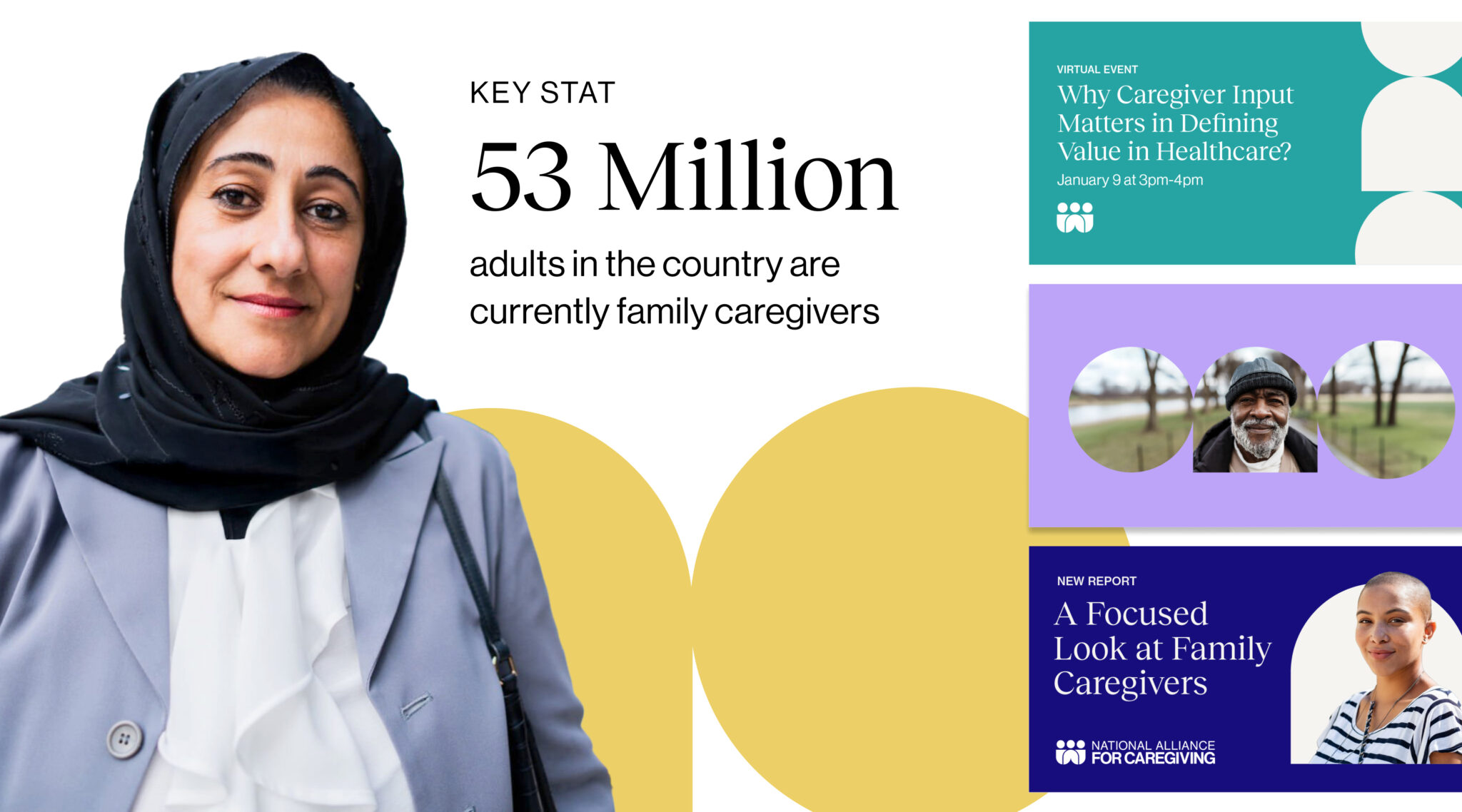
The caregiving sector is one of the most essential in American society. According to the latest Caregiving in the US report from AARP and the National Alliance for Caregiving, about 63 million Americans, or a quarter of adults over 18, have a family member at home who needs care. And nearly 1 in 4 caregivers report providing 40+ hours of care per week.
Unfortunately, despite their importance, when it comes to caregivers and the caregiving workforce as a whole, both are too often under-recognized and under-supported. The COVID-19 pandemic helped raise awareness of and appreciation for caregivers as essential workers, creating a long-overdue movement that increased national visibility. Still, America has a long way to go to establish the necessary systems and policies to truly support caregivers and recognize them for the economic value they provide for this nation.
For nearly 30 years, The National Alliance for Caregiving (NAC) has been at the forefront of this push for greater recognition and reward for the caregiving sector. Their research and advocacy work have been vital to advancing equitable systems of support for family caregivers across America—translating grassroots experience into evidence-based policy and research that strengthens and supports the sector as it stands shoulder to shoulder with caregivers.
Approaching its 30th anniversary as an organization, NAC saw this as a critical opportunity to reimagine its brand to meet the moment and speak to the next 30 years of impact. It was clear the organization needed a brand identity that reflected both its grassroots origins and its credibility as a national thought leader. NAC partnered with Constructive to develop a brand that reflects their momentum and sets the tone for the future of care in America.
Discovery & Research: Understanding NAC’s History & Future Aspirations
Every strong brand begins with a clear understanding of who they are as an organization, what they stand for, and how they want to be perceived by their stakeholders and audiences. For NAC, that meant beginning the process with one of Constructive’s core exercises: the Learning Conversation.
This structured discovery session provides leadership with an opportunity to reflect on the organization’s past and its future direction. With nearly three decades of impact and national momentum building around caregiving, NAC was at an inflection point. Stakeholders shared how the existing brand felt outdated, unmemorable, and no longer reflected their sophistication. They voiced that the overall colors and impression, “aren’t necessarily conducive to who we are and what we want to promote in terms of our mission, our vision, and our compassion.”
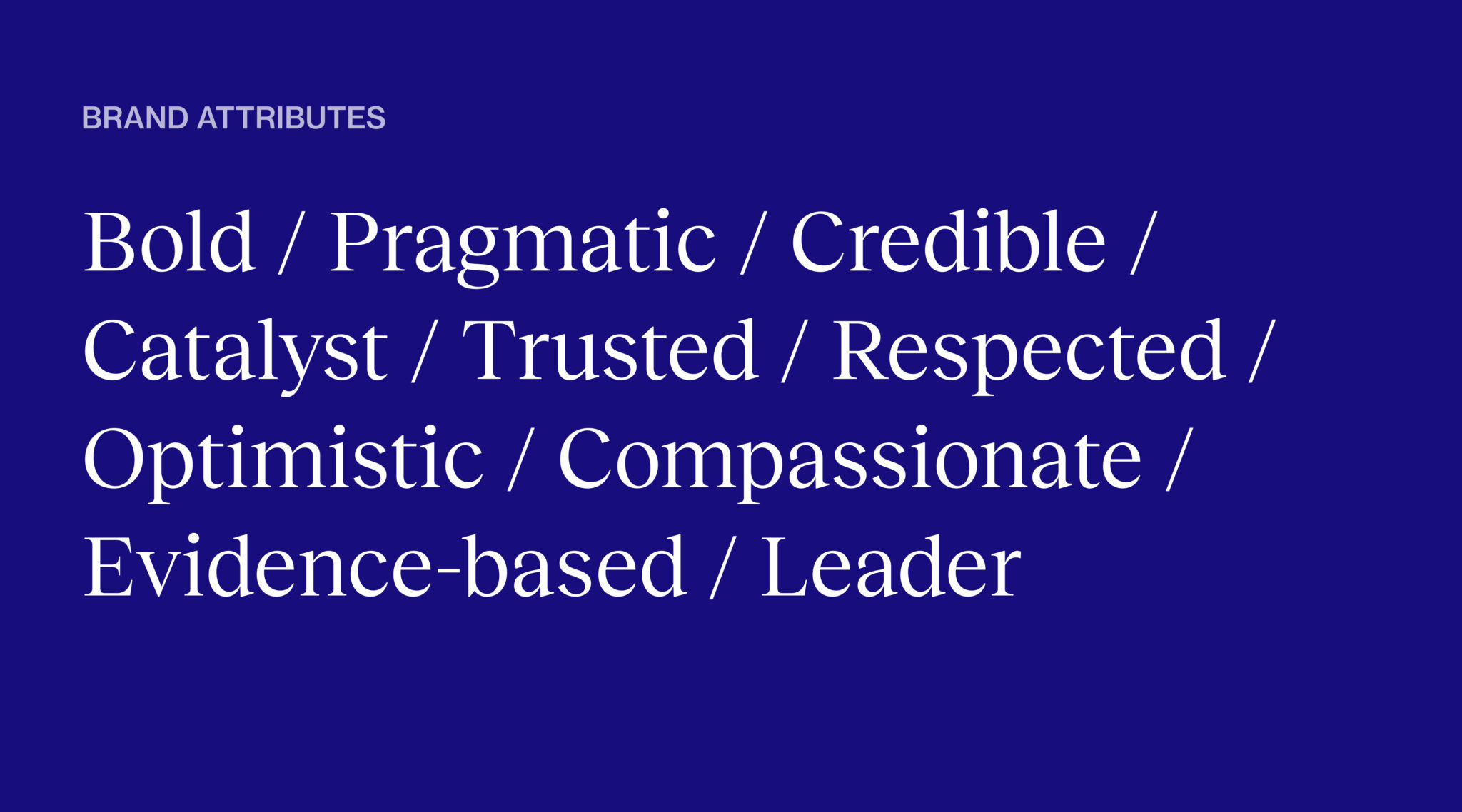
To articulate the brand’s personality and positioning, we facilitated a word-based exercise to capture the attributes NAC wanted their audience to associate with the brand. To help drive our visual ideation, we compiled examples from within and outside the health sector to understand what resonated and why. This visual exercise is especially helpful for stakeholders who are less fluent in design language, as it enables them to offer their reactions or impressions when discussing color, visuals, and typography preferences.
Stemming from our conversations, the following principles served as our North Star as we moved into visual design:
Be bold and visionary: Challenge outdated perceptions of caregiving and advance a future where family caregivers are valued, supported, and empowered.
Be a catalyst for systems change: Stand strongly with partners and speak with credibility and authority about the need for sector transformation.
Be rigorous and rooted in evidence: Speak with authority and credibility to policymakers, advocates, and alliance members about the policies needed and the evidence that supports this transformation.
Be a voice for caregivers: Authentically amplify real caregiver voices and experiences to drive advocacy and inspire action.
From Dated to Durable: Reimagining the Brand Logo & Mark
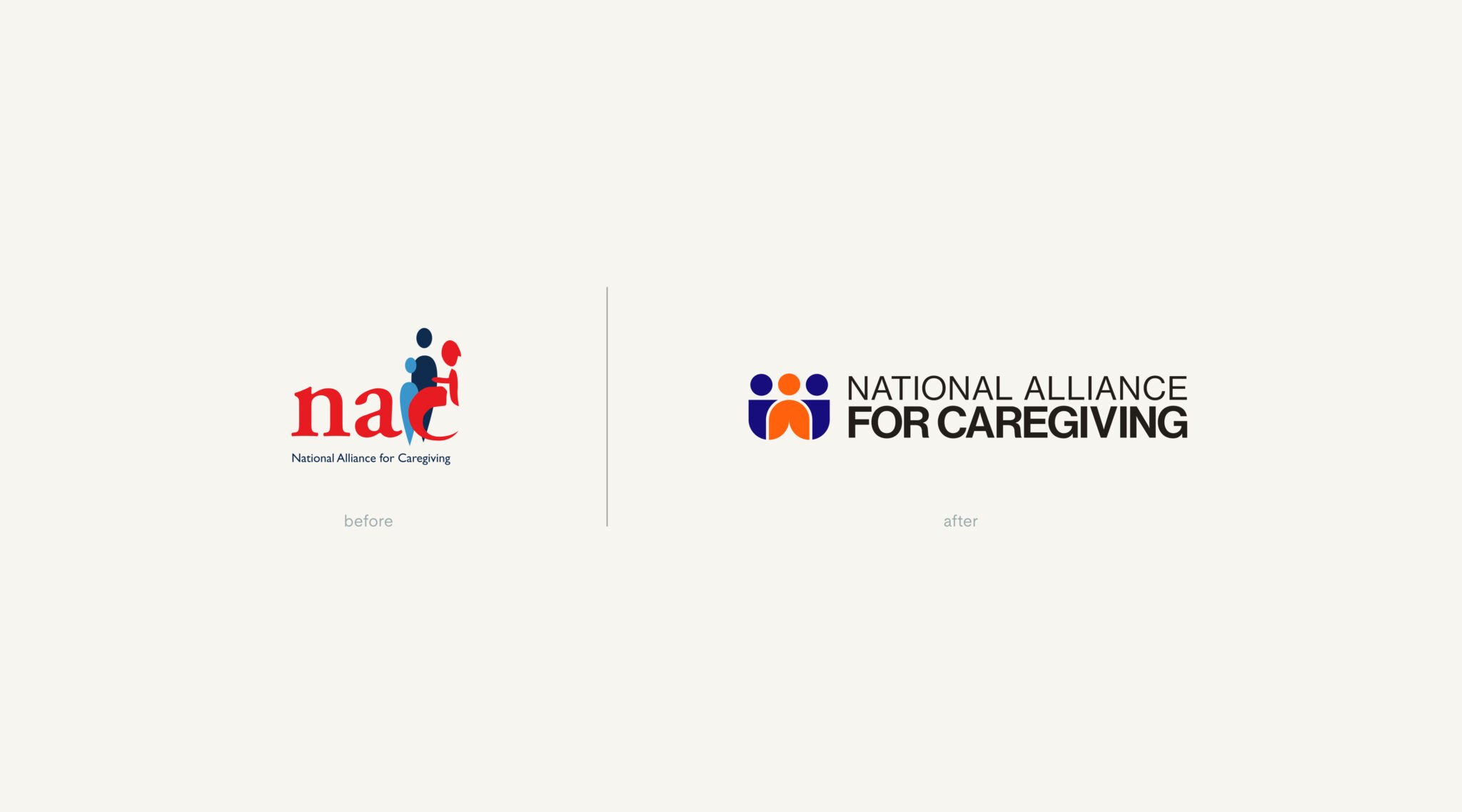
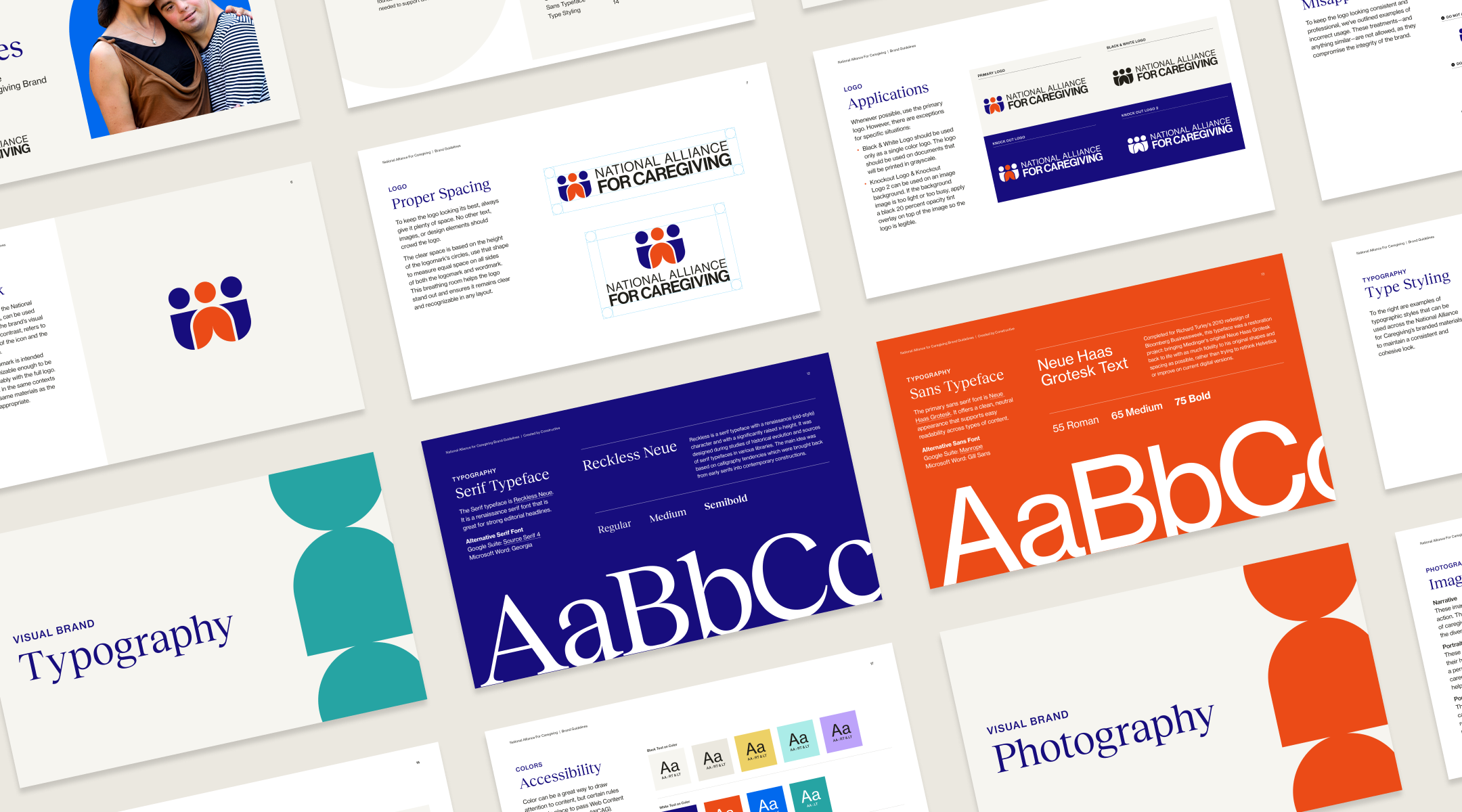
One of the first noticeable changes we made when reimagining the brand identity was ensuring the organization’s full name was clearly legible in the logo, which helps with overall brand awareness. We moved away from using NAC as a shorthand to avoid diluting the strength of the organization’s name. The previous mark, once considered progressive for its symbolic nod to disability through a wheelchair-like figure, wasn’t necessarily discernible at a glance. We responded with a bold, geometric logo system rooted in clarity and accessibility. The new typographic mark strikes a balance between the gravity of policy work and the warmth and community that caregiving represents. Central to the design is the trio of human figures—symbolizing not just an individual caregiver but also the broader community of support that surrounds them.
Embracing Boldness: A Stronger Spectrum of Color & Typography
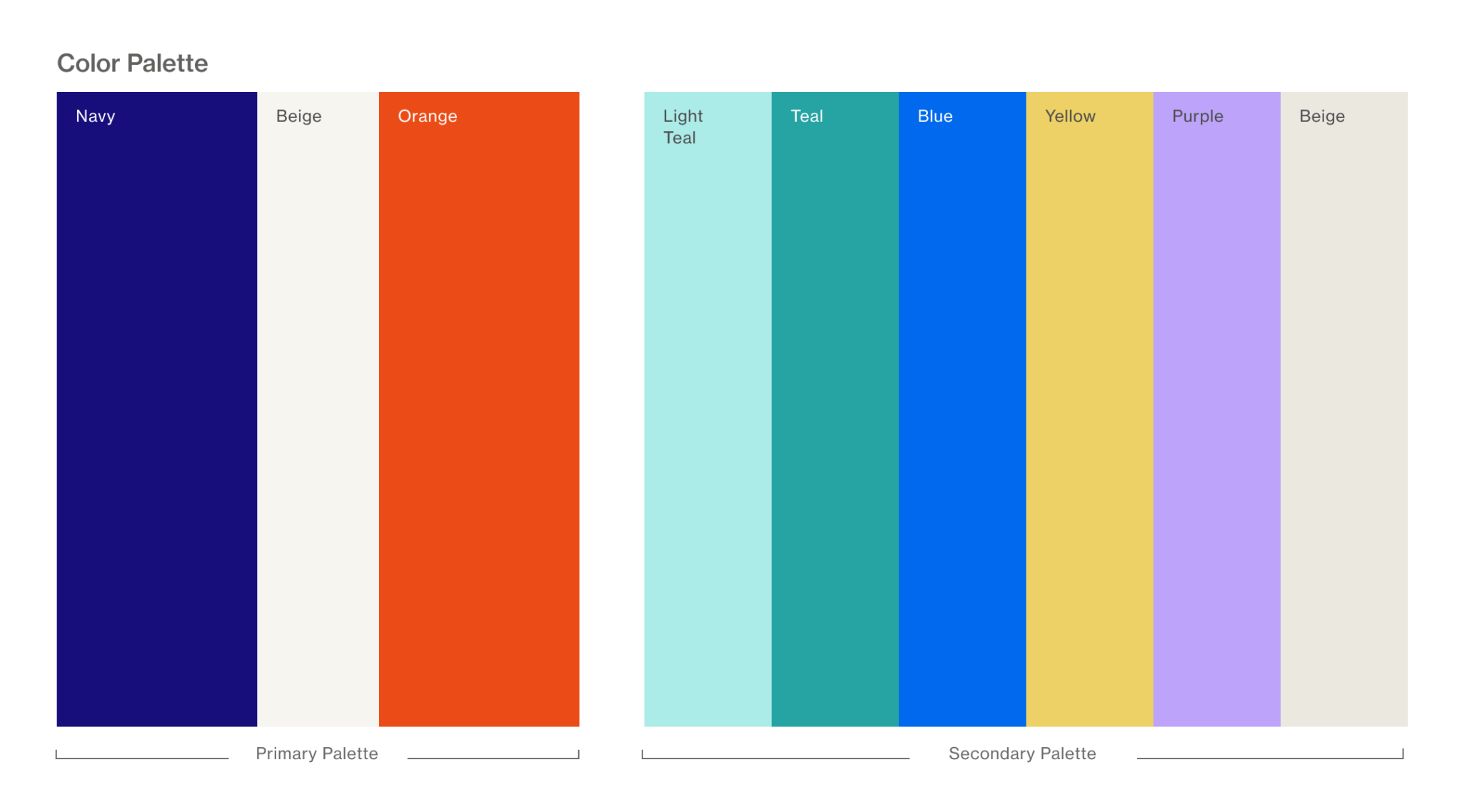
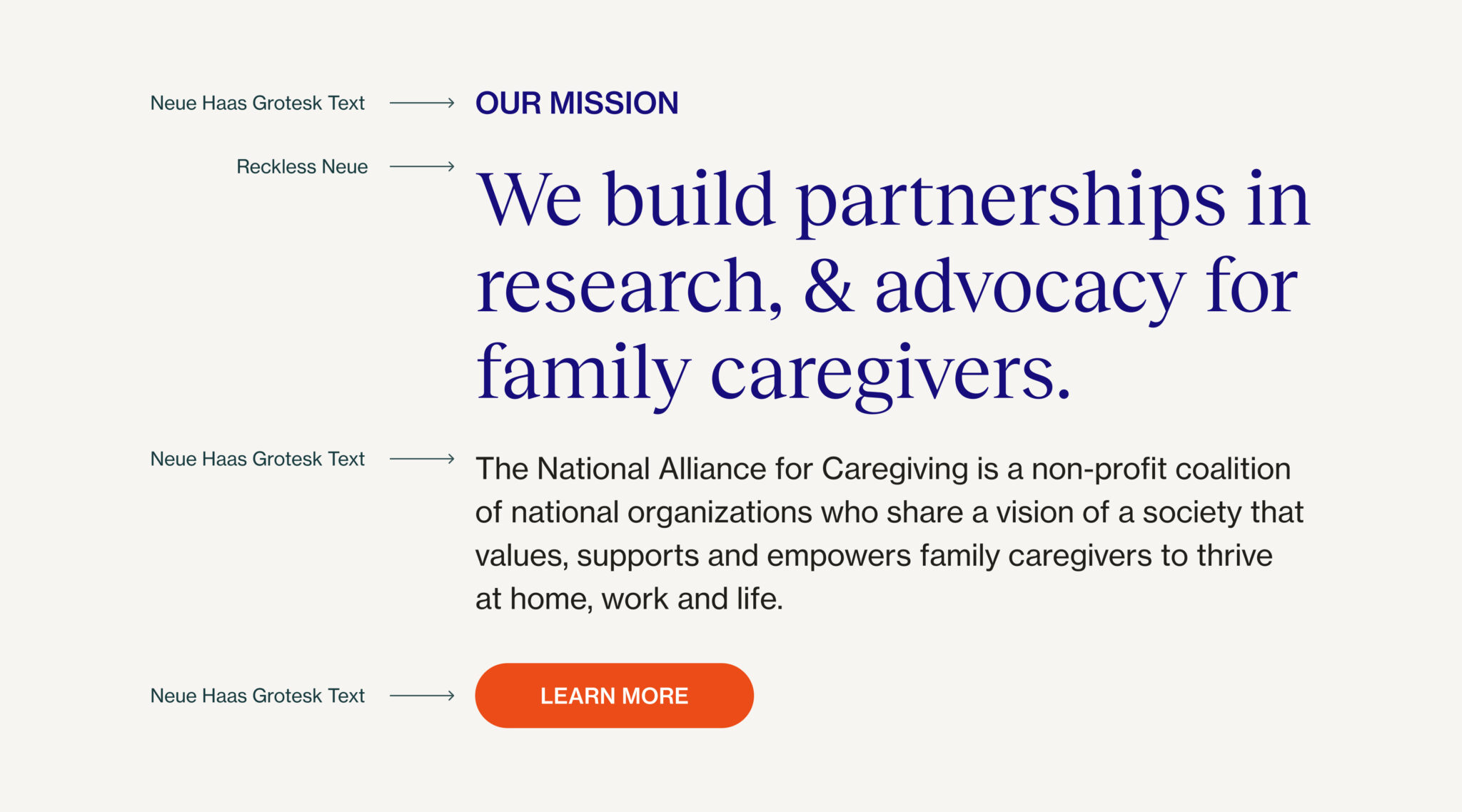
During our discovery sessions, the NAC team shared that they wanted this rebrand to feel “different and durable.” To visually express the duality of NAC’s brand—uplifting caregiver voices and driving policy change—the new brand centers on a deep blue that conveys credibility and leadership. We chose a vibrant orange to bring warmth and urgency to the front, supported by a broader palette of human-centric tones. This resulting palette is both flexible and uplifting, allowing for a range of expressions, from strong and reassuring to vibrant and optimistic. When considering typeface, we prioritized accessibility and legibility. We chose a sans-serif typeface as the workhorse font—something clean, durable, and super legible that could reliably handle our body text, interface elements, and functional content. Our serif font plays a more specific role, appearing in headlines and key messaging where its personality adds warmth and a human touch to the brand.
Ethical Visual Storytelling: Putting Caregivers in the Spotlight
Caregiving is inherently human and extremely personal, so the rebrand’s photography needed to reflect this carefully. NAC’s new visual direction emphasizes natural lighting, neutral poses, and diverse caregiver stories in authentic environments. While many images are stock due to geographical and logistical constraints, we prioritized selecting images that prioritize realism over polish. We aimed to create a library of photo assets that felt honest, intimate, and inclusive, while portraying vulnerable populations in an ethical and dignified manner. We ensured we chose images of smiling figures and scenes that respected the humans in the process while demonstrating their strength and dignity. For portrait cutouts, we isolated images of caregivers in front of bold background colors to allow these individuals to really stand out and shine.
Brand Guidelines: Delivering a Cohesive Brand System for Scale
One of the key points that emerged during our early conversations with the team was the need to streamline and scale content production to live within the same brand umbrella. NAC emphasized the need for a system that staff and stakeholders would actually want to use. We developed a brand book that brings clarity and flexibility to NAC’s communications. A strong foundation of shapes, color, and typographic hierarchies allows the brand to adapt without sacrificing consistency or starting from scratch every time. These guidelines are designed to establish a strong visual foundation while allowing for the creative flexibility needed to support their diverse communication needs.
Beyond Web: Extending the Brand Across Channels
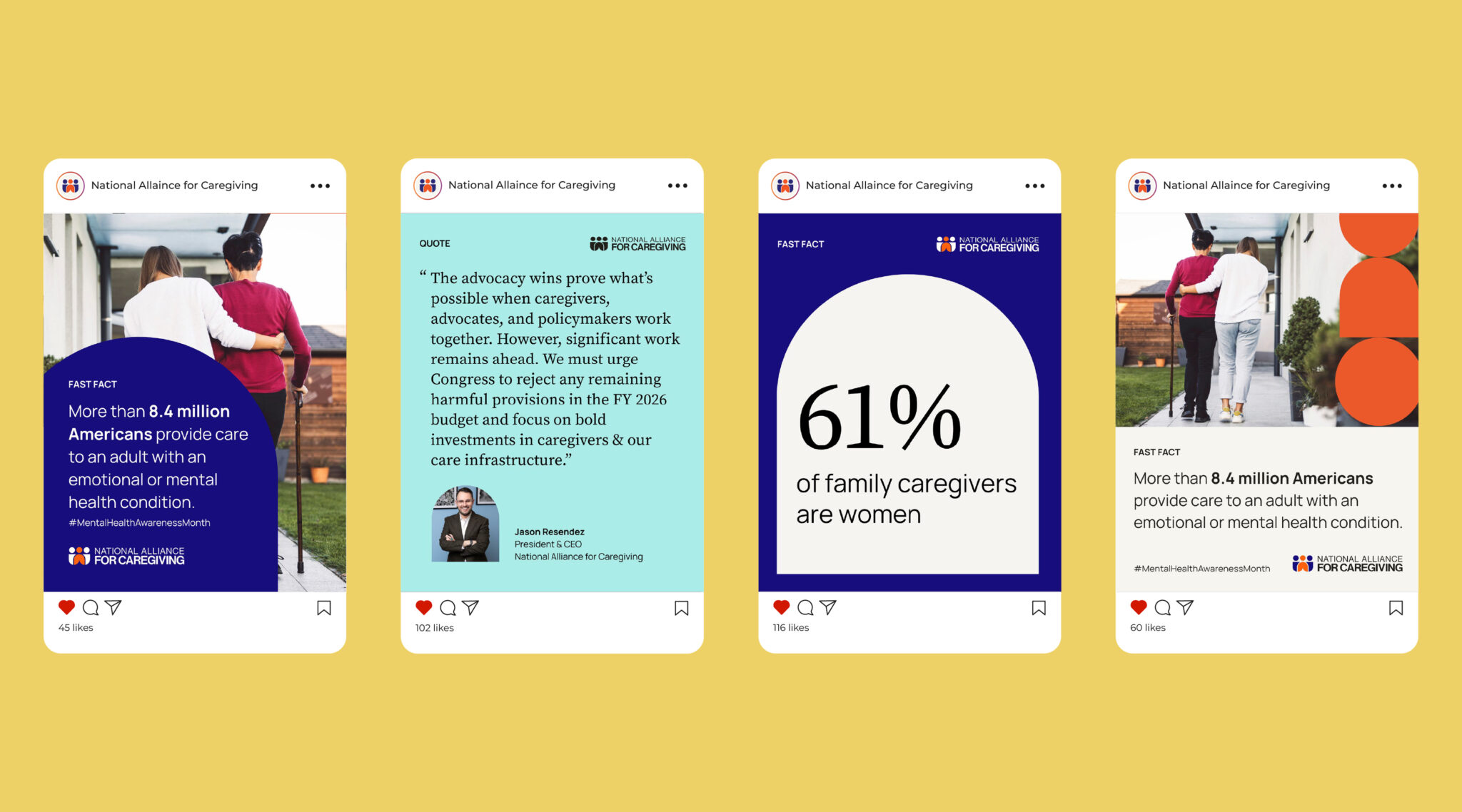
To support consistent, real-world application of the new brand, our team delivered a suite of branded templates and materials for the NAC team to customize, including:
Social media templates to customize in Canva
Presentation templates
Business cards
Letterhead
White paper and report layouts
These templates will help NAC communicate clearly and confidently within the new design system, regardless of where the content appears.
Ready to transform your nonprofit brand? Get in touch to see how we can partner with you!
When it comes to bridging the divide between abstract concepts and tangible impacts, visual storytelling is one of the most powerful tools we have to engage people with our ideas. As far back as cave paintings, visual stories have been a cornerstone of communicating human values, deepening understanding, building empathy, and shaping our culture.
Fast forward a few thousand years, and digital storytelling is the new cave painting. We’re saturated with content. We have shorter attention spans. Cross-cultural connections and communication around the globe are the norm. And in this world, video, animation, and motion design give communicators powerful visual tools to make ideas more meaningful and memorable, ultimately helping people to carry them forward.
The sophistication of today’s world raises important questions. How do we visually explain complex, nuanced ideas without oversimplifying them? How do we quickly—and ethically—visualize social challenges without reinforcing the very stereotypes we want to dismantle? And how can we effectively help audiences move from understanding into action?
FrameWorks Institute has been leading research into cultural mindsets for decades, building a rich, accumulated library of information, evidence, and ideas. For their most recent research initiative, we collaborated to create Mindsets & Movements—a dynamic video motion graphic series and social media campaign that uses ethical visual storytelling to dive deep into how Americans understand and act on the essential mindsets of Individualism, Otherism, and Fatalism.
In this article, we’ll walk through how we embraced these challenges with FrameWorks to develop a visual storytelling strategy that activates their research on cultural mindsets in America to shift dominant narratives, reframe how people communicate about the ways mindsets influence our lives, and make the conversations and actions connected to them more productive.
Collaborative Storyboarding to Structure the Narrative
FrameWorks’s team came to us with fully developed scripts and studio footage, along with annotated drafts that suggested where visuals might help clarify or reinforce the speaker’s narration. From there, our team brought the concepts to life through visual design, typography, and motion graphics. But first, we started our process with collaborative storyboarding led by our Senior Designer, Doug Knapton. Doug’s approach began with static frame-by-frame mockups paired with notes describing how each moment would animate on screen.
These storyboard frames served as a shared language between our design team and FrameWorks’s communications and research staff, allowing us to map out visual components, align on the overall direction, and ensure clarity of the concept being communicated. From there, we worked iteratively across all five videos. Storyboarding was especially valuable in identifying where animation could elevate a moment or where it might be distracting. Ranging from three to five minutes, these videos had to not only educate the audience on complex topics but also engage viewers in a way that wasn’t overwhelming or jarring.
Design Strategy to Visualize Complicated Social Science and Abstract Concepts
Early conversations with the client helped us align on the larger creative direction for how the video series would interact with FrameWorks’s existing design system and extend into its other channels. Having previously partnered with FrameWorks Institute on their brand refresh and website redesign, we had a solid design foundation to build from. The goal of the FWI website is to convey the rigor of the organization’s research with a more muted, subdued color palette and editorial approach. For this series, we aimed to evolve the visual language, creating an engaging experience for social and marketing while staying within the brand guidelines. To ensure consistency, we adapted the established brand system by evolving the subdued color palette into more saturated hues that would pop on screen and keep viewers engaged for the entirety of the video series.
To bring this visual language to life, we needed a system that could help viewers grasp complex ideas. What makes cultural mindsets so important is that they are so widely shared. Everyone accesses and experiences them. When it comes to explaining them, as FrameWork’s Director of Communications, Carinne Wheeden, explains, “The goal isn’t to say any mindset is wrong—it’s about understanding how to foreground or background them through strategic communication.”
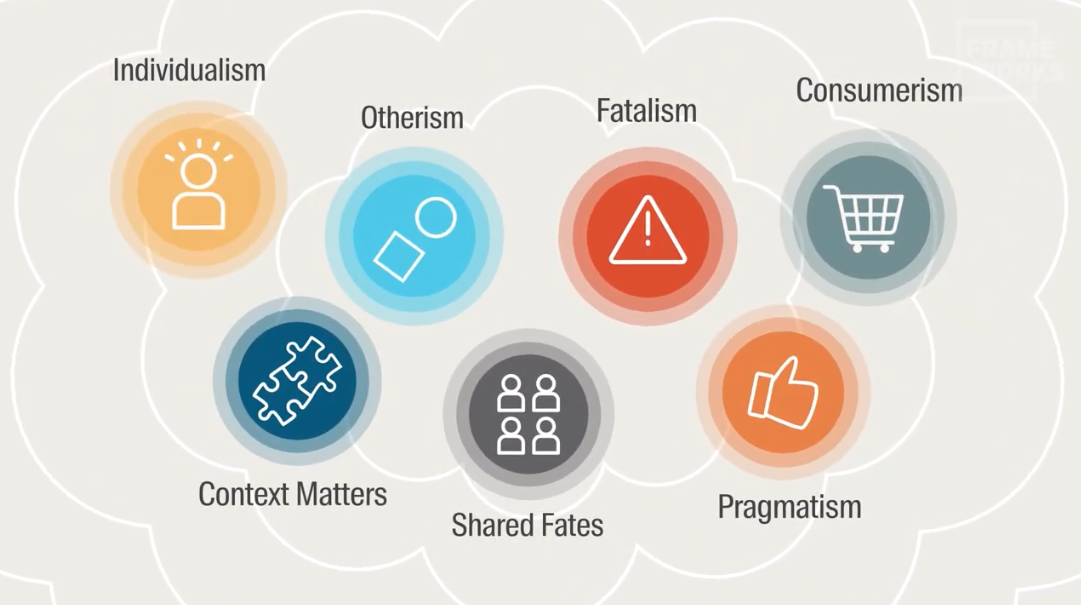
At the heart of our visual strategy was the need to communicate that the cultural mindsets of Individualism, Otherism, and Fatalism aren’t just individual beliefs but are widely shared and systemic. We developed a set of animated visual motifs to reinforce this idea: shapes that ripple outward and grow bigger when highlighted to allude to their pervasiveness and wide-reaching impacts. We intentionally developed symbolic, color-coded icons—yellow for Individualism, blue for Otherism, and red for Fatalism—to give the FWI team a consistent visual shorthand for use across presentations, reports, and future videos. These new icons, along with a system of animated shapes, metaphors, and thematic color palettes, provide flexible tools for visual storytelling that maintain clarity and consistency.
Ethical Visual Storytelling That Shifts to More Productive Narratives
The research that FrameWorks shares is often complex, abstract, and by nature, not inherently visual. And when it is visual, there’s a real risk of unintentionally reinforcing the same stereotypes and misconceptions their work seeks to dismantle. Throughout the process of designing this video series, we carefully scrutinized every image, icon, and animation to ensure it aligned with their mission and communicated the core concept without bias or misrepresentation.
We asked ourselves: Would it mislead? Reinforce a bias? Oversimplify a system? We worked to avoid reductive representations, especially around topics like race, poverty, and health. When considering the inclusion of people’s photos, we discussed how facial expressions could easily veer into cliché or stereotype. Instead, we leaned into abstraction and metaphor, creating visual motifs that encourage reflection. For example, we explored how to convey concepts like the savoir complex or structural racism without flattening them into a single image. Equally important were the decisions made about what not to show. There were moments where we deliberately used typography, narration, or negative space in place of visuals. By doing so, we avoided forced imagery that might be reductive and let the speaker truly speak for themselves. Knowing when to show versus tell became a guiding principle across the series.
Motion as Meaning: Activating Ideas With Engaging Animation
While storyboarding and visual design were essential to shaping the narrative, it was the animation that truly brought the experience to life. Combining studio interview footage with custom motion graphics, we created a dynamic play between spoken word and visual metaphor. Each transition, sequence, and visual cue was carefully calibrated to support the script’s narrative arc and set a pace that maintained momentum. We also focused on the dynamic between speakers and visuals, ensuring they worked together instead of competing for attention.
Translating our static storyboards into animation revealed unique challenges throughout the process. Some metaphors worked better in motion, while others lost their effectiveness. As Doug explains, “I had to break down the voiceover word by word to get the timing just right. Sometimes too much motion overwhelmed the message.” We iterated closely with the client throughout the process, ensuring each visual sequence aligned with the pacing of the speakers while supporting the narrative’s overall arc. The end result is a seamless flow between expert voiceover, time on screen, and conceptual visualization that deepens understanding and strengthens impact. Animation became the connective thread that tied together framing science, expert voices, and the audience’s viewing experience.
See the Work
This project demonstrates what’s possible when communicators, researchers, and designers work together to translate complex research into accessible and actionable content. We leaned into each other’s expertise, challenged assumptions, and emerged with new perspectives. This video series clearly communicates FrameWorks Institute’s extensive research and equips advocates, communicators, and policymakers with tools to better tell their stories and shape productive public narratives.
Partner with Constructive to use video, motion design, and visual storytelling to translate complex content into engaging experiences!
Recently, as I’ve continued to check the traffic to our nonprofit client’s websites, I’ve noticed a distinct pattern. Organic search traffic is no longer reaching the numbers it did in years past. Across organizations in various sectors of the nonprofit industry, with differing website sizes and objectives, this pattern appears to persist. And there are new traffic sources popping up, too: ChatGPT, Perplexity, and Gemini. As a Digital Strategist, I’ve watched as the website landscape has continued to change and evolve drastically as AI has become further integrated into our lives and our search habits. A key part of website success since the dawn of the internet has revolved around organic search. But whether nonprofits can continue to rely on organic search is another question.
For many nonprofits, your website is your single largest touchpoint with those you serve and work with. Whether your website aims to introduce potential donors and clients to your work, reconnect with existing partners and share successes, collect donations, or another key function, its success is vital to advancing your mission.
Organic search brings people right to your website from their search queries, introducing your organization to first-time visitors and making it easy for returning users to come back. Google has long held a near-monopoly status over organic search traffic. However, with several significant changes to Google’s search engine over the past few months and years, for many nonprofits, organic search traffic is now offering diminishing returns.
We’ve seen a number of our clients’ websites attracting fewer users, page views, and clicks from organic search, to no fault of their own. Search engine optimization is a larger and more challenging topic than ever before, and additions to Google search engines, such as SERP features (search engine results page features), are changing users’ habits in real time. The recent global expansion of Google AI overviews is especially changing the landscape of search in new and meaningful ways.
This begs the question: how can we adapt and strengthen our website traffic when we can no longer rely solely on Google? Unfortunately, the answer isn’t quick or straightforward. However, there are several ways we can use this opportunity to strengthen outbound tactics that enhance our website traffic, increase our visibility among broader audiences, and refine our organization’s marketing strategy. First, let’s talk a bit more about what’s currently happening with organic search.
What’s the Current State of Organic Search?
The organic search landscape is changing, as is our technology landscape as a whole. And organic search engines are just one part of the tech landscape that’s been largely shaken up by AI. Even if you’re far from being an SEO expert, you’ll be familiar with what I’m referencing. When you search on Google, you’ll no longer see the top results displayed simply as web pages to click on to find an answer. Instead, a Google AI overview now often pops up as the first result, offering you an answer right there—no click necessary. Semrush has reported that AI overviews are on the rise, with 13.4% of all queries triggering overviews in an extensive study they conducted in March 2025. While the AI overviews are often still far from accurate (and Google has suggested that they aren’t intended to reduce website traffic), many website owners have been tracking their organic search losses back to this feature, in addition to others.
The jury’s still out on the degree of the effect that AI overviews have had on website clicks over recent months. Some small studies have aimed to demonstrate the impact, with one study from Ahrefs asserting that clicks have been reduced by up to 34.5% for informational keywords, which trigger the most AI overviews. And now that Google continues to expand overviews into new regions of the globe and new languages, and Google is introducing a separate entirely AI search experience, there’s no question that the typical search experience will continue to change.
User behavior patterns are changing, too. More users have begun to incorporate LLMs like ChatGPT, Perplexity, or Gemini into their toolbelt for answering their queries. It’s unclear whether these behavioral changes will result in any meaningful market share loss for Google. Still, the development is noteworthy as website managers begin to ask not only how they can gain visibility in Google, but also how to utilize these AI tools.
The effects of these changes are both felt and seen on many nonprofit websites. While the current moment is a necessary time to consider pivoting away from a heavy reliance on organic search, it could also be an interesting opportunity to reassess how our website appears to our audiences and rethink our ideas of success.
How Can You Reduce Your Website’s Reliance on Organic Search?
Build an Outbound Strategy
We often refer to simple reliance on organic search traffic as an “inbound-only” approach to website traffic. But with Google’s diminishing returns and the ever-increasing uncertainty of this moment in time for nonprofits, it’s unwise to lean just on inbounds. Instead, we can invest and build our outbound strategies to find where our users are—and bring them right to us.
Learn Where to Actually Find Your Audience
For many organizations, you may currently have only a rough idea of how audience members are finding you and your website. Starting with this research is crucial, so you don’t end up investing a significant amount of time and resources into building digital channels in online spaces where your audience doesn’t typically congregate. There are a number of ways that you can consider conducting this audience research, such as:
Intake forms: If your website includes a sign-up or log-in feature, include a field on the sign-up form that asks visitors to confirm how they found you (e.g., search, social, from a colleague, etc.). Alternatively, if you have a newsletter, you can include this question in your email subscription form.
Questionnaires: Add a small live survey to your website’s homepage using a tool like Crazyegg to ask similar questions.
Audience interviews: Conduct more comprehensive user research by interviewing audience members to discover how they found you and what keeps them coming back.
By doing this research, you’ll learn more about your website visitors, understand if they align with the audience you’re trying to reach, and discover why they’re visiting in the first place. And you will know where your users are, so you can build channels that meet them there.
Invest in High-Return Digital (and Even Offline) Channels
Next, you will need to invest necessary time and resources into the digital channels that you have identified through research efforts as the most impactful for our organization. These channels may include:
Social media platforms like Instagram, YouTube, or TikTok. These are especially beneficial if your audience tends to be younger or if your work is more visual.
Newsletters and content hubs that allow you to share updates, insights, and resources regularly.
Online forums and communities where your audience is already active, such as Reddit, Slack, Discord, or closed LinkedIn groups.
Direct outreach and partnerships to individuals or organizations that could benefit from what you have to offer.
Whatever channel you’ve identified as the most valuable for your organization and how you define website success, invest in it. Likely, the quality of the individuals you bring back to your website from these dedicated activities will be even better than those Google sends your way, meaning stronger connections with audience members and a higher likelihood that they will engage and continue to engage with you. It’s worth cautioning that both doing this business development and marketing work isn’t easy, and it’s not easy to do well. But it’s perfectly alright to test and iterate.
It will likely take a few attempts to identify the channels and marketing strategies that your organization should prioritize, and these channels and strategies should evolve over time. Even though this work takes ongoing time and effort, I don’t think we as social impact organizations have a choice to not do this work anymore. The more our organizations can stand on their own two feet without relying on Google, the less thrash we’ll see as Google and search behavior continues to change.
Prioritize People, Not Just Crawlers
It’s important to remember through all of this work that at the crux of building this outbound website strategy is designing for real humans, not search engines or web crawlers. It can become easy, especially when trying to rank higher in search results, to end up with a website or outbound marketing content that feels like it’s built for a machine to digest, rather than a human. And the internet is completely rife with this kind of content (not to speak of content that is fully AI-driven and almost incomprehensible). As we see a rise of low-quality content, it will become increasingly more important to create meaningful, people-centered experiences. This means:
Writing for clarity, comprehension, and connection (and not just keyword density).
Showcasing authentic voices, stories, and proof of impact (and not just jargon or filler).
Prioritizing accessible and inclusive language to welcome all audiences.
In some cases, the best “channel” to reach your audience might not even be digital! No matter what the why is for why people need to come to your website, or where they come from, people want to feel that their time is respected and valued. If Google’s shifting search landscape prompts us to reconnect with our audiences in more human, intentional ways, perhaps this is a positive outcome overall.
Final Thoughts
We’re in a very uncertain moment for social impact organizations more generally. Especially for those who collect donations from their website, and those who have experienced recent funding losses, websites are key lifelines in how our space operates. With all of these shake-ups, it seems like decreasing organic search traffic is just one of many challenges right now. However, it can be tackled with a great deal of intention, focus, and effort. Reducing your organization’s reliance on Google is one opportunity to take matters into your own hands and ensure that there’s one less piece of uncertainty to contend with.
If you’d like to learn more about how we develop dedicated websites and marketing strategies for our clients, please get in touch!
As political rhetoric and uncertainty ramp up, nonprofits face pressure to show (and not just tell) how they’re making a difference in the world. Supporters, funders, and even your own team are looking for transparency that connects the dots between your values and actual results.
Enter: The annual report. This still remains one of the most essential tools in your nonprofit communications toolkit. It’s your chance to zoom out, celebrate your community, demonstrate your impact, and make the case for continued support with clarity and conviction.
Our team explored a variety of digital annual reports and impact reports that rose to the challenge. If you’re planning your next impact report or looking to sharpen your approach, we hope this roundup gives you some fresh perspectives to learn from. Here are the reports from 2023/2024 that stood out to our team (in no particular order).
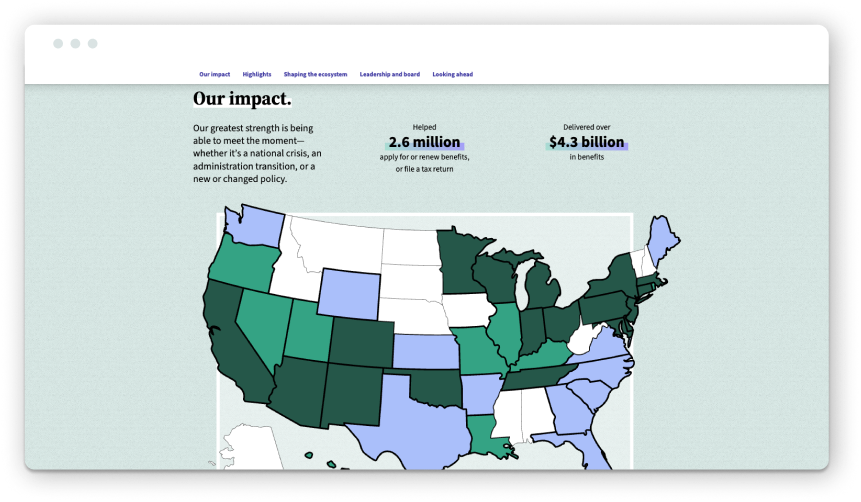
Code for America’s 2024 impact report immediately signals that it’s not just recapping the year. The opening letter from CEO Amanda Renteria sets the tone: “2024 was a year marked by change—some of it exhilarating, some of it daunting, but all of it underscoring the urgency and importance of Code for America’s mission.” Acknowledging the challenging ecosystem grounds the report and shows how the organization is responding to the times, not just reporting on the numbers.
The report uses vibrant colors, illustrations, and subtle motion to guide users through the experience while keeping it engaging. The scroll experience is super smooth (if you want to read from start to finish), but we also appreciate that the report includes a table of contents with jump links at the top so readers can navigate to specific sections based on their needs.
Bold headlines bring the narrative to life and showcase their highlights at a glance, such as “modernizing government services to deliver better for all.” The report also does a nice job of breaking content into digestible bites to reduce cognitive load and improve readability. Code for America weaves a compelling story throughout and reinforces itself as a leader in the civic tech space. It ends strongly with the final CTA, inspiring readers to take action: “Now, our charge is to keep the momentum going even as the world around us changes.”
Nonprofits looking to elevate their annual reports shouldn’t just turn to other nonprofits for inspiration. We also highly recommend taking a look at B-Corp and socially responsible businesses. REI Co-op’s 2024 impact report is proof of why! And yes, while organizations like REI most likely have a heftier production budget for their reports, there is still plenty to learn from how they structure content and create immersive experiences.
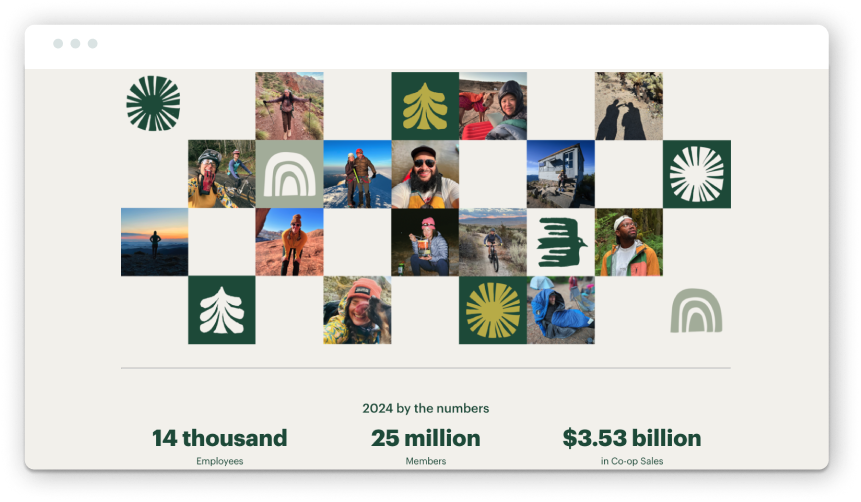
From the start, the report pulls you in. A full-width hero video brings us right into the fold (literally) by showing REI team members gathering in a huddle. This makes it feel like we’re also part of the community and shared purpose. Instead of opening with a letter from their CEO, this bold statement sets the tone for the report: “We’re on a mission to get everyone outside. And every single one of us plays an essential part. The proof is right here in this report. It’s a living, breathing tapestry of individual stories that make up our collective drive onward and upward as a co-op.”
That sense of collective impact is reinforced throughout. Candid photography sourced from REI team members at events and enjoying the outdoors adds a feeling of authenticity. Design elements like fonts, colors, and iconography are cohesive and rooted in REI’s outdoor aesthetic.
We also really appreciate the report’s structure. While many digital reports opt for the simplicity of a long-scroll microsite, REI uses a multi-page approach to allow deeper exploration. Readers can jump from impact stats, community work, and sustainability milestones or dive into stories that bring the data to life. The navigation—guiding users clearly and quickly from section to section while also offering a sidebar table of contents—ensures that the reader can explore any chapter in the report without necessarily forcing them to go through every section.
The report also does a great job of balancing narrative and numbers. Clean charts and infographics make the data digestible, and curated stories give readers a sense of the people behind the impact. At the end of the report, they include a content block that links to past reports going back to 2006. It’s a simple but effective way to provide historical context and transparency, which we don’t often see done well in annual reporting.
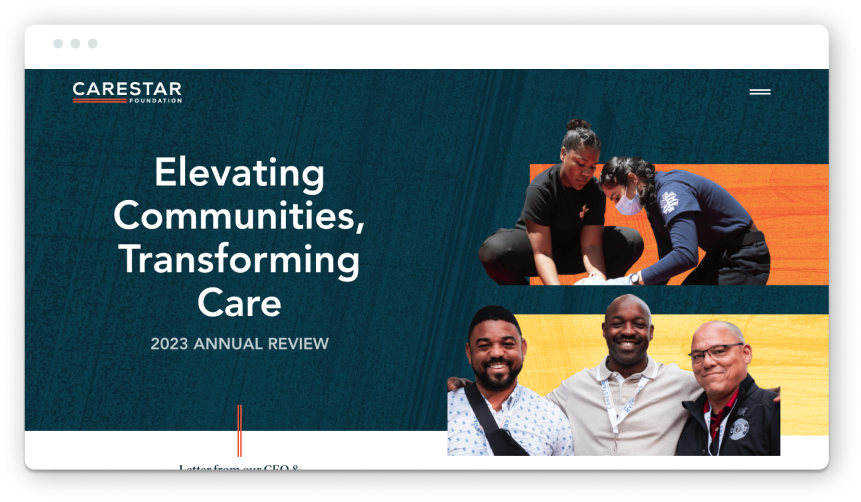
We’re proud to include this report in the roundup, and not just because we had the privilege of working on it! CARESTAR’s first-ever impact report is an excellent example of what it looks like when brand, strategy, and storytelling align.
CARESTAR Foundation came to Constructive at a pivotal moment. After six years of learning and growth advancing racial equity and community-led action, they were ready to reflect on their progress and share a vision for what comes next. The goal: create an impact report that honors where they’ve been and outlines where they’re going.
We began the process with a staple of Constructive’s research and discovery process: the Learning Conversation. This facilitated dialogue brings all stakeholders together to share perspectives, align on goals, and define what success looks like. In those early conversations, CARESTAR’s four brand values emerged as the foundation for the report content strategy: Equity, Compassion, Unity, and Hope.
From there, we built the narrative structure around those brand values. Each content section connects directly to one of the guiding principles and features tangible stories of impact with grantee highlights, research insights, and community resources.
Visually, the report is warm, vibrant, and expressive. A new palette of bright, complementary colors adds energy, while introducing a serif typeface adds legibility and a human touch. Background textures and field photography add depth and emotion, rooting the design in real stories and CARESTAR’s community.
As you can see with this example, impact reports are essential for organizations of all sizes and stages to consider, even if they aren’t created annually. We designed this report to be a reflective report capturing 6 years of progress and a forward-facing tool to engage funders and inspire grantees in the months and years ahead. An annual report does more than look back—it builds momentum for the future.
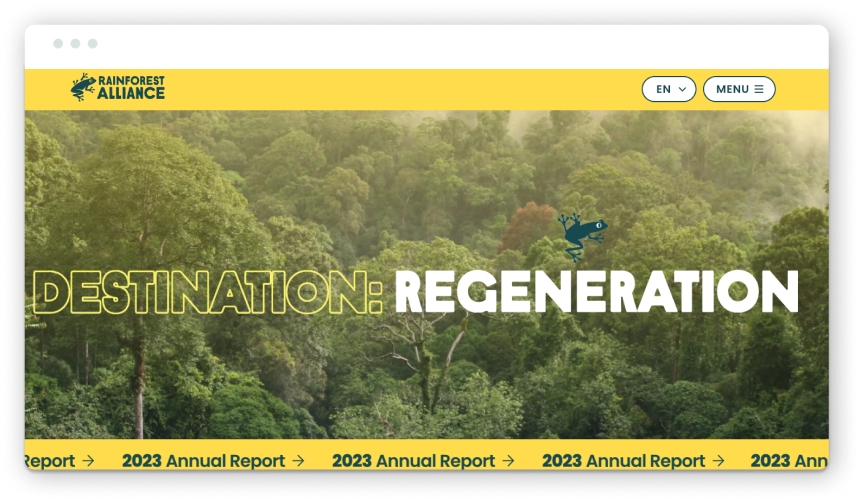
Did we include this report because of the animated jumping tree frogs? (Maybe). But that’s not the only reason it made the list. You’re brought right into the rainforest when you land on this landing page. The scrolling “2023 Annual Report” banner at the top also catches your attention.
What’s working well on the design front: A rainbow of colors reflects the organization’s global biodiversity work, playful animation adds personality, and oversized type creates an easy reading (and scanning experience).
From a functionality standpoint, one feature that’s helpful for this report (as it references a whole host of other reports and case studies) is a simple expanding accordion so that content is nested and doesn’t clutter the experience, but users can expand to read more if they’re interested in the topic. This click-to-expand option makes content scannable, elevates the highlights, and allows audiences to choose which details they want to immerse themselves in.
From the name of the report (Destination: Regeneration) to the copy throughout and the colorful design, the whole experience feels hopeful. We often see organizations in the climate space lead with doom and gloom, so we appreciate that the Rainforest Alliance takes a different approach here by focusing on progress and regeneration. This positive framing inspires the audience to take action instead of becoming immobilized by anxiety.
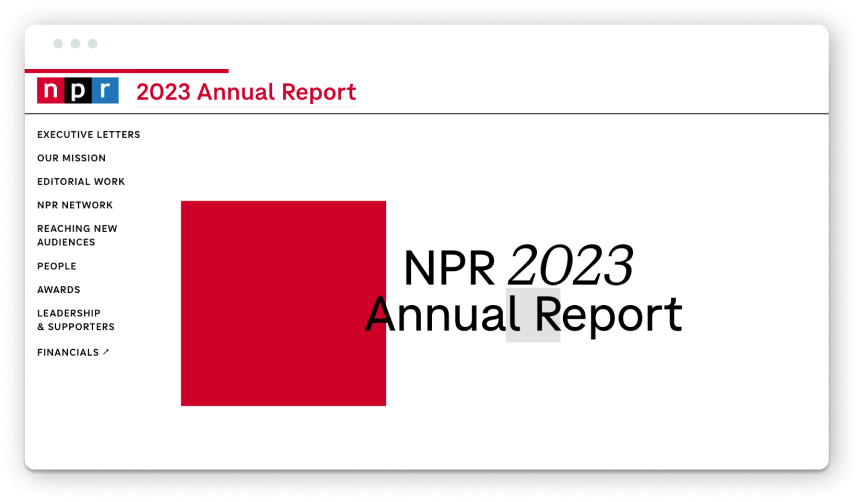
This one from NPR is fun, and we don’t usually say that about annual reports! It’s as engaging as it is informative and substantive. They do a great job of balancing editorial polish with interactivity. The report is structured like a well-crafted editorial feature with body copy, pull quotes, and multimedia content to guide the reader.
We enjoy the on-brand (and intentional) use of color throughout the report, along with subtle motion as you scroll (both vertically and horizontally). A nice touch: photography features local reporters and Member Stations, grounding NPR’s national presence in local communities. From a messaging perspective, there’s a strong emphasis on what’s made possible with public support. Readers learn their contributions helped the team serve 42 million readers weekly, produce 12,000 newscasts, create 120 Tiny Desk concerts, and publish over 14,500 podcast episodes. There’s a sense of shared accountability and success.
And, of course, it aligns with what NPR is known for: high journalistic standards, public service, and storytelling. In our books, this report lives up to their reputation.
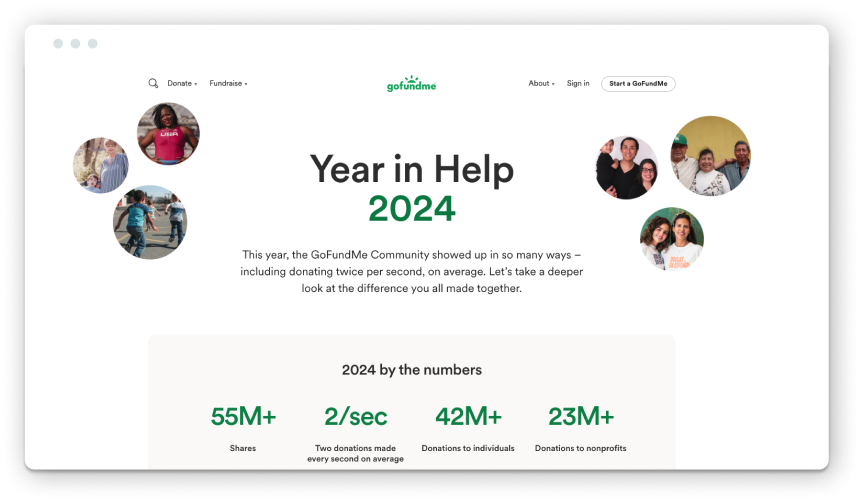
“Let’s take a deeper look at the difference you all made together.”
This report example from GoFundMe isn’t an organizational annual report per se but more of a celebration of community impact. And it works. It’s an interesting approach for platform-based organizations that operate to help their audience take action through fundraising, volunteering, or advocacy. By shifting the spotlight on the community by saying, “You made a difference,” GoFundMe shares the collective impact.
The report jumps right into 2024 by the numbers, showing just how widespread the impact is (with two donations happening every second, on average). That momentum sets the stage for the stories to follow. Yes, the big performance numbers are impressive. But what stands out is the report’s ability to zoom in and balance individual stories of neighbors stepping in to help one another when tragedy strikes.
A few design moments stand out: Branded graphics of maps show the most generous states and cities. Clean, modular content blocks and card-like modules break sections into digestible bites. Images of real people from real fundraisers, short videos, and quotes bring community stories to the forefront. It’s a lengthy page, but it doesn’t feel that way.
“In moments of uncertainty, there was generosity.” It’s a powerful theme, and the report delivered on it.
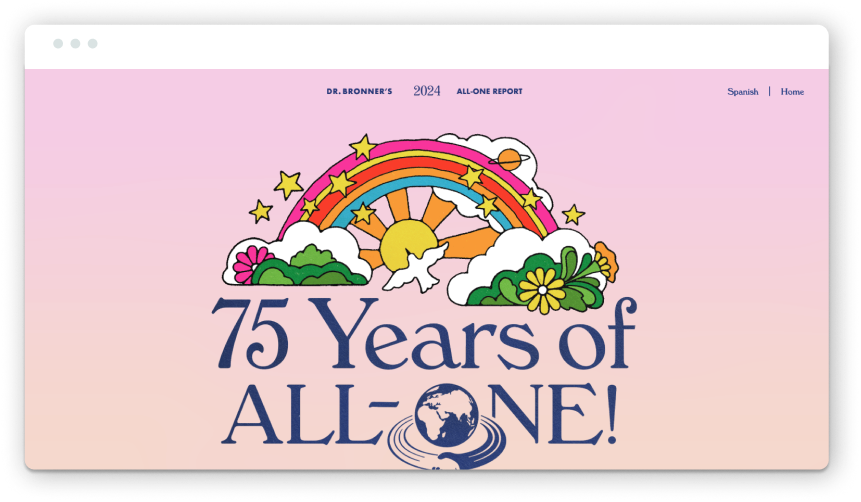
If you’ve ever picked up a bottle of Dr. Bronner’s soap and read the label, you know exactly what to expect from their report. It’s just as detailed and eccentric (maybe not as wordy).
Can we say a soap brand’s annual report is … refreshing? Vibrant color, whimsical illustrations, collages, subtle animation, and joyful photography all come together in a design that’s as bold and values-driven as the brand itself. It feels like a uniquely Dr. Bronner’s experience through and through.
The report structures its content around the company’s Cosmic Principles, a set of guiding values that drive the entire business. Each principle anchors a report section, paired with real stories and measurable impact. (It’s a structure that reminded us of how we approached CARESTAR’s annual report).
Every design and content decision feels intentional. Copy blocks are expandable, allowing readers to skim or dive deeper. They decided to present stats and charts in carousels, which invites users to scroll through without overwhelming them. And in a particularly on-brand move, their revenue breakdown is visualized in the shape of a soap bottle. Delightful.
Underneath all of the creativity, this report is radically transparent. We need more storytelling and accountability like this.
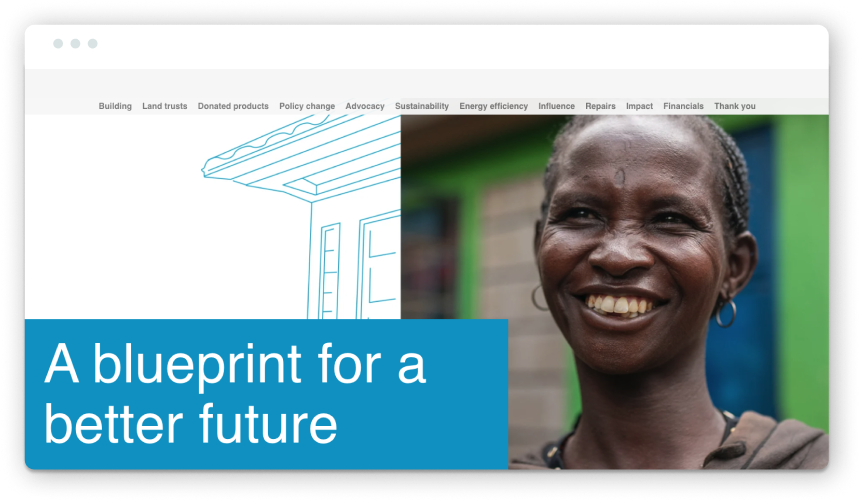
We’ll start by saying that this report from Habitat for Humanity doesn’t check all of our best practice boxes, but we think it’s worth spotlighting what it does do well. There’s no such thing as a “perfect” annual report, and this one gets plenty of the essentials right.
The report is rich with stories, program updates, and performance numbers. And maybe it’s a little bit too content-rich. A few sections could be trimmed a bit to make the content more digestible and less dense. That said, at its core, the messaging effectively communicates organizational progress and centers the people it serves.
The interactive map at the end stood out to us the most in terms of functionality. As you scroll, the map displays data by region and shows the scale of the organization’s impact worldwide. Helper text and table labels provide additional clarity without cluttering the screen. The use of motion while scrolling makes it feel immersive.
The title of the report, along with the blueprint-style linework and background textures, all tie together nicely to ladder back up (sorry, pun intended) to Habitat’s work and mission. The connection between building together and collective impact is evident in both their messaging and photography.
Interested in Exploring More for Your Nonprofit’s Annual Report?
Check out our past annual roundups with inspiration from 2020, our favorites from 2022, and standout examples in 2023. You might recognize a few repeat appearances, which speaks to these organizations’ ongoing commitment to creating reports that are both tailored to each year and aligned with their long-term brand strategy.
And if you want to explore the potential of building a great report for your organization, reach out anytime to work together. Maybe your report will make this list next year?
Kaylee Gardner, Digital Strategist at Constructive, contributed to this roundup!
Crafting the right nonprofit brand messaging can be especially challenging for organizations working on climate communication and knowledge mobilization, where urgency, scientific complexity, and polarization collide. But for some further hope and creativity in our approaches, I know one place we can look to for inspiration: up North. The Arctic is a particularly interesting region for discussing climate change, cooperation, and degradation. As a result, the region is rife with examples of effective—and ineffective—climate narratives used by politicians, leaders, academics, and organizations alike to change minds and move agendas.
At Constructive, I’ve spent years helping mission-driven organizations, including those in the climate sector, shape meaningful narratives and digital strategies that drive impact. In 2024, I took a sabbatical from my role as Digital Strategist to dive deeper into a topic I’ve long been passionate about: The Arctic. I moved from Hoboken, New Jersey, to Reykjavík, Iceland, where I enrolled in a semester-long graduate program at Háskóli Íslands (The University of Iceland), studying the intersection of climate, cooperation, and policy in the world’s northernmost capital.
Through my coursework and attending the Arctic Circle conference, I realized that many of the insights I gained about climate communication and cooperation in the Arctic have broader relevance across the climate space. I found invaluable lessons on how storytelling, framing, and trust-building can shape public perception and policy across continents. In this article, I’ll share some of those takeaways and explore what they might mean for nonprofit communicators and practitioners in their corners of the world.
Cultivate Unity: Frame Climate Action as a Shared Purpose
Something that became immediately clear to me from reading scholarly work and attending the Arctic Circle conference was that climate change—and the need to tackle climate change—is a real unifier in Arctic geopolitics. For instance, one of, if not the most important facets of Arctic governance and cooperation today is The Arctic Council. Established in 1991 with a focus on environmental protection, the Council includes representatives from the eight Arctic states, Arctic Indigenous Peoples, and various observer representatives. While the original environmental protection strategy that started it all has since evolved into a council that discusses an ever-widening number of issues, the environment and climate change work remains a central concern of the forum’s working groups. In this way, a commitment to the climate has brought together the Arctic states into much wider avenues of research and resource cooperation, as well as providing an essential forum for Indigenous voices to be heard.
The foundation for such cooperation can, in part, be traced to the deep connection between the Arctic Peoples’ climate and their identity. In the Arctic, the climate isn’t something that’s ignored or disregarded societally—it’s a piece of Arctic Peoples’ identity and something that people from different nations or Indigenous groups share. The ice, Aurora Borealis, long dark polar winters, Arctic flora, and fauna are unique in nature, and as Arctic scholar Ingrid A. Medby puts it in an academic article on Arctic identity, it’s “not about owning the Arctic, but about being Arctic.” Indigenous people have lived on the ice for generations, relying on their understanding of the environment for survival, with some surviving on subsistence hunting and living nomadic lifestyles. In the Arctic, the climate is the way of life, and people from various Arctic states and Indigenous communities feel kinship with each other because of their shared environment.
Often in climate change communications, we discuss avoiding polarizing ideas or language—we just assume that the climate is a topic that may pull people apart. While it’s important to consider how climate change can be a polarizing topic, we see in the Arctic that it has an intense capacity to bring people together. Climate communicators can remind people of this by referencing examples of impressive climate collaboration that have already taken place (like I just did in the Arctic) to overcome the often-encountered hesitations that climate change is too large or insurmountable an issue for us to tackle.
And it’s not only Arctic Peoples that must live in harmony with their environment, so climate communicators can take on the vital role of reminding everyone, including city dwellers, people living in tropical locations, or other non-Arctic locations, that the unique aspects of their climate directly impact their lives and their community. While the Arctic may have especially strong links between identities and the climate, these links are ever-present worldwide.
Demystify Complexity: Communicate Climate Science with Clarity
For Arctic Peoples, the effects of climate change are often not distant concepts. Instead, they are real effects that are both seen and felt. However, this doesn’t mean that communicators can make blanket assumptions about the knowledge levels of any audience, because climate change is intensely complex.
Consider Greenland, where the glaciers have been melting, and the climate has been changing at rates that are perceptible to Greenlanders. A recent study showed that while around 89% of the largest Greenlandic Inuit people group, Kalaallit Nunaat, agree that climate change is happening, only 52% percent of the population in the survey indicated they knew climate change is primarily caused by humans. Even among Arctic Peoples and Arctic policymakers, scholars, and students, there are still varying degrees of climate knowledge and understanding.
Take another example. On the last day of the Arctic Circle conference, I listened to a plenary session titled “Is the AMOC Shutting Down?.” In this session, Stefan Rahmstorf, a Professor of Physics from Potsdam University, spoke about the Atlantic Meridional Overturning Circulation—a water circulation pattern along the Atlantic Ocean. He presented proof that scientists have seen that the AMOC is weakening. The proof shows the circulation pattern has been slowing over recent years, creating a “cold blob,” a section of water in the Northern Atlantic region that’s cooling significantly, as well as causing significant warming of waters off the Eastern United States Coast. Professor Rahmstorf discussed this evidence as well as future tipping points and potential climate consequences of an AMOC shutdown, including significant surface temperature changes and changes in rainfall patterns regionally and globally.
As the talk ended, I remember looking around the large conference hall full of Arctic professionals and seeing a number of faces with the same degree of shock I was feeling. While there were undoubtedly some who were intimately familiar with the AMOC, I spoke to multiple scholars and my fellow students at the conference who were also either unaware of the AMOC entirely or had only a vague idea about its functioning and the potential consequences of changes. Even among regional experts, there’s still much to learn about the various and complex phenomena related to climate change.
As climate communicators, we need to always remember this. It’s our job to break down complex topics without assuming any knowledge levels (while treating our audiences with respect and recognizing and relating to audience members with lived experiences). We can connect the real experiences of climate change to the more complex science and consider when and how much complex information is needed in each scenario.
For me, the information presented on the AMOC built a bridge to a better understanding of a phenomenon I already knew was taking place: the warming of the Atlantic off the Eastern coast. As a lifelong New Jersey resident, I was very aware that there were discussions about the waters off the beaches warming every season. While I knew this was caused by human-induced climate change, I was unfamiliar with the slowing of the AMOC. Once again, this drives home that while Arctic Peoples may be more intensely feeling the effects of climate change right now, there’s not one human on Earth who has not experienced some type of climate disturbances. We are responsible for building the bridges between these experiences and the information about them that our audiences need to take informed action.
Recognize Economic Realities: Reframe Incentives for Climate Degradation
While there already are—and there will be—more negative consequences to climate change in the Arctic region, this isn’t the only regional narrative that’s been at play for the last few years. At the beginning of my university program, as I was introduced to the Arctic region across various courses, there was much talk of “A New Arctic.” The “New Arctic” has “New Drivers” of action and economic reward. As the Arctic ice melts, new, potentially lucrative opportunities have arisen in the region. This includes new polar shipping routes that could potentially be faster and cheaper, as well as further extraction of precious resources from Arctic lands and oceans.
This is an apt time to mention a very topical development in Arctic geopolitics: Trump’s attempt to purchase Greenland. While security is one factor here, an arguably larger reason for Trump’s interest is economic: the belief that as Greenland’s ice melts, new opportunities for drilling rare materials will present themselves. While a lot of these opportunities are still just hopes for the future, undoubtedly, their possibilities are affecting Arctic geopolitics right now. There are a number of questions being raised over who “owns” polar routes, how and where extractive activities should be completed, the effects of these new industries on the climate, people, and more. While there is still steadfast commitment from regional actors to stop Arctic ice from melting, one could argue that there are also significant incentives at play for some to keep the ice melting (or even to accelerate its melting).
This was eye-opening for me to learn. It got me thinking about our approaches to climate communications, specifically our tendency to focus on why climate degradation needs to stop while often not addressing some of these potential incentives for the climate to continue to change. We cannot just ignore these motivations. Rather, we need to explain them and explain why this talk of embracing climate change and giving up the climate fight is not the answer.
Unfortunately, we must consider how enticing some of these “embracing” climate change ideas can be. Shorter shipping routes leading to faster shipping of items at cheaper rates sounds great on the surface. But when we present these potential positives with the adverse effects of Arctic sea ice loss (such as more extreme weather, sea level rise, permafrost melting, releasing more greenhouse gasses into the air, etc.), now our audiences can see the full picture.
We can also use our communications to stray away from the binary. Luckily, in the Arctic, the interests in these new economic opportunities have not yet meant less focus on the climate. We need to communicate that the choice that’s often presented between a strong economy and a strong climate isn’t the only option; rather, we can continue to consider the climate in discussing how we can grapple with economies in a rapidly changing world.
Prioritize Transparency to Build Trust in Your Organization’s Impact
Arctic geopolitics may seem full of impressive and perhaps unprecedented cooperation, but to say only this would be ahistorical and untruthful. Like any other area of the globe, there are a host of actors with various goals at play, and as a result, we see some tensions between states and other actors involved in the region. Especially with the recent changes in the Arctic, some Arctic specialists have been suggesting that security in the region is ever-increasingly unstable. The Arctic Circle conference I attended was widely regarded as the most security-focused event in its 12-year history.
One of these areas of tension within Arctic geopolitics comes from the participation in Arctic affairs of non-Arctic states—states that do not possess any Arctic territory. Non-Arctic states, such as China, Japan, and many others, often make their case for being involved in Arctic work on the basis of climate change. Arctic leaders in such states suggest that because the Arctic is so important to our climate, it makes the region the concern of all nations, not only those directly possessing Arctic land. As may be expected, not all leaders from states with Arctic territories agree with this notion. Some leaders fear that non-Arctic states may be only using climate change as a pawn to gain more power in the Arctic region, a place that may become an economic powerhouse in the future if the ice continues to melt.
We see the same types of hesitations from a number of actors in the climate space; donors need to be skeptical about the organizations they are entrusting with their money. As social awareness grows, so does greenwashing—the act of organizations misleading the public about how much environmental work they accomplish. Arctic leaders are largely concerned that non-Arctic countries are doing essentially this—greenwashing their intentions in the region.
As communicators, we need to lay out the facts of exactly what our organization is working on and where, showing our impact clearly in numbers, words, visuals, and more. We all know the value of transparency, but it’s worth reiterating here. Consider keeping track of questions your organization often gets and finding ways to answer them on your website or in your other marketing channels (such as social media, newsletters, etc.). You can never offer too much information to reassure your audiences.
To Wrap Up
There’s a global idea that Arctic collaboration is “exceptional,” and this type of climate work just cannot be done outside the region. This idea has specifically thrived in global geopolitics ever since the creation of the Arctic Council, which functions without any comprehensive legally binding nature even today. And it’s true, the Arctic represents a unique region of transnational collaboration among people with strong shared identities who see climate change happening in their homes. But, just because this is all true doesn’t mean we should write off the lessons that Arctic work can teach us more widely as activists, nonprofit workers, and communicators.
Something I noticed throughout my coursework and the Arctic Circle conference was that the way forward in the Arctic is still unclear, and so room in the sector is being made for discussions of all possibilities. During the Arctic Circle conference, I heard a number of voices and dissenting voices (often even in the same room). People asked hard questions. People agreed. They disagreed. One of the most notable aspects of the conference is that anyone of any status can ask a question to any leader, even figures as prominent as NATO Admiral Rob Bauer. As a new Arctic student, I was allowed into every room and every conversation. The open communication astounded me.
For me, the Arctic represents hope. Hope for continued and further climate commitments more globally into the future. I’m excited to continue to learn more about what the future of the Arctic may hold, and I’m excited to apply all of these communication takeaways with our clients here at Constructive.
In Arctic geopolitics, you will hardly go a day without hearing a few familiar catchphrases. While these terms may be industry clichés, I will end with one that particularly resonates.
“What happens in the Arctic doesn’t stay in the Arctic.”
As the saying goes, “your brand isn’t what you say you are, it’s what they say you are,” which is why audience research is essential to brand strategy and design work. Social impact organizations do their best to influence people’s perceptions of their organization, and every brand expression and experience they create is connected to their brand strategy. After that, it’s up to the people who engage with them—inside and outside the organization—to decide what they think and feel.
It’s a complex, multi-faceted dynamic with a pretty simple calculus: your brand is only as strong as how well you understand your audience, how effective you are in meeting people where they are, and if you deliver the value they’re looking for. If the goal is to have what audiences say you are become aligned with what you say you are, then how you show up in the world better be aligned with what matters to them.
There are a lot of ways to gain the insights needed to define and design a successful social impact brand. At a high level, one is through direct experience, and the other is through research.
On the direct experience front, everyone who works at an organization understands its audience to a degree based on their interactions and how open their eyes and ears are. Brand strategists and designers understand an organization’s audience based on how much they’ve worked in their sector or issue areas (which accumulates experience with similar or the same audiences).
On the research front, there’s a mix of scale and style to the approach. First is more qualitative and intimate: things like interviews, workshops, and questionnaire-style surveys. These are invaluable to gaining individual perspectives and nuanced understanding. Second is large, quantitative research: primarily statistically valid brand surveys that paint a picture at scale.
In my experience, qualitative research accomplishes a lot: it’s lean and effective for most nonprofits working on their brands. Experienced internal stakeholders are a good proxy for understanding audiences and what matters to them, targeted external interviews and questionnaire surveys build on that knowledge, and agency experts complement this with their accumulated experience.
Quantitative brand research, though, is a science. Instead of relying more on our experience and intuition, we’re after statistically valid data to inform our choices as we shape the brand to meet audiences where they are and deliver the value that they’re looking for. As with all things data, the quality of the evidence depends on the methods for collecting it.
Enter: the art and science of survey design.
When doing brand research at scale, it’s not enough to just ask good questions. How a survey is structured determines how effectively it will engage audiences and generate reliable evidence. Poorly designed surveys—ones that are too vague, too long, or unintentionally biased—can lead to flawed insights and misinformed decisions. A well-crafted survey provides nonprofits with trustworthy data on audience perceptions, needs, and motivations that are invaluable for understanding brand equity and creating effective brand messaging, design, and experiences.
Again, for most nonprofits working on their brands, I firmly believe that a combination of stakeholder expertise in the sector and issues plus thoughtful, small-scale research is appropriate and effective. For large organizations, membership nonprofits, associations, publishers, some foundations, and others, large-scale surveys designed with scientifically sound best practices can be invaluable to empowering people to make informed decisions about how to shape the brand.
I’ve worked closely with my friend and strategic planning consultant, Professor Ann Murphy, who is an expert in survey design, to shape Constructive’s approach to quantitative survey design. It’s built on 6 steps that ensure organizations ask the right questions, in the right ways, and in the right order to effectively engage audiences and deliver the insights needed to make informed decisions about a nonprofit’s brand.
Step 1. Define Your Nonprofit Brand Survey Strategy
It sounds obvious, but to guarantee that your survey adds value, start by defining your objectives. Without a clear purpose, a survey can become a simple checkbox exercise to satisfy stakeholders rather than a strategic tool that drives informed decision-making. At a high level, here’s what this looks like:
Outline Objectives and Outcomes
Before you write a single survey question, clearly define its higher purpose and what you specifically want to learn from the results. By doing so, you’ll strategically guide every decision, from survey design to analysis, made by the people working on it. For example:
Are you looking for general brand health feedback or initiative-specific insights?
How can your survey complement and build upon other research methods?
What type of data do you want to gather? Are you looking for qualitative feedback, sentiment analysis, or demographic trends?
How will the survey support and inform your strategy going forward?
Once you’ve established your survey’s purpose and priorities, you can now focus on which audiences you will engage with it.
Identify Core Audiences
To generate valuable survey results, it helps to ask the right people the right questions! This can look like one survey for all audiences, or, depending on your organization’s size, survey segmentation allows you to target different questions to different audiences. Either way, you’ll want to ask yourself:
Who will participate in the survey and what demographic mix do we need?
What is their relationship to or familiarity with the brand? Have they participated in previous surveys, and if so, how can we build on that experience?
What are their motivations? How can you incentivize responses to increase participation?
The more intentional you are about survey audiences, the more relevant the results—which drives higher participant engagement and creates more accurate data.
Consider the Broader Potential
Yes, the primary goal of a brand research survey is to inform how the brand shows up in the world and the experiences it creates for people. It also has the potential for broader application in strategic communications and knowledge mobilization that can benefit a nonprofit’s partners or the field. You’ll be putting a lot of time and effort into your brand survey, and it will generate a lot of information. Are there ways you’d like to use this to benefit more than your brand?
For example, can your research shape a case study or white paper that helps similar organizations understand how they can more effectively engage their audiences? Can it be used to create a research report that can help strengthen the sector your organization works in, bring in new players, or foster cross-sector collaboration such as public-private partnerships? Would sharing results through strategic communications and directly with your audiences deepen understanding and build greater trust and engagement?
You’ll be putting in the time, so plan in advance for how you and others can get the greatest amount of good from it!
Step 2. Draft Questions and Test Your Survey
Much like there is a thorough testing and QA process during website design to make sure that what you’ve created will work as intended, it’s a good idea to make sure that you get initial feedback on your brand survey in a controlled setting so it’s clear and usable to your audience and delivers the results you’re looking for. From the questions you create to a test run of the survey, you’ll want to:
Develop Strategic and Well-Structured Questions
There’s a science to designing effective brand surveys that provide results you can rely on—which, not surprisingly, is determined by the questions you ask. The sum is greater than the whole of its parts, and your combination of questions—and the order in which they are asked—work together to deliver a more complete picture of audience beliefs, perceptions, and preferences.
Quantitative data is structured, numerical, and measurable. It’s collected through closed-ended questions like multiple-choice, Likert scales, or rankings. Qualitative data is generated by open-ended questions and text responses, allowing respondents to share their thoughts in long-form writing or via interviews. And beyond the style of question, most important, is to make sure that your work does not create unintentional bias or skewed results.
To start, there are a few best practices:
Avoid leading questions that can create bias or suggest the answer you’re hoping for.
Diversify the question structure to create a rhythm that keeps participants engaged with each question.
Create a mix of open and close-ended questions to generate quantitative and qualitative data.
If you build it, will they come? Not necessarily. Any time you create a survey, you’re asking people to take time out of their day to give you information. Depending on their relationship with your brand, that may or may not be important to them, so how can you make sure that your audience is willing to participate and properly engage?
According to HubSpot, 47% of consumers say they’re most likely to abandon a survey if it’s taking too long, so prioritize essential questions to respect people’s time and prevent drop-off. Constructive’s best-practice target to maximize engagement is a survey that takes 10-15 minutes to complete. To avoid survey abandonment, you can also consider the following ethical survey design best practices:
Respect privacy and anonymity (disclose if you’re collecting emails)
Disclose survey length or time commitment at the beginning
Include a progress bar or question #s to show progress
Consider a multi-page design over continuous scrolling
Only make the essential questions required
Make It Accessible
Designing with accessibility in mind ensures your survey is clear, concise, and usable for all respondents. Beyond applying standard ethical design principles, it’s essential to consider your target audience and their individual needs. This accessible survey design checklist is a helpful starting point:
Device Compatibility: Is the survey accessible across mobile phones, laptops, tablets, or other device types?
Format: Is the survey available digitally and in person to accommodate preferences or access to technology?
Clarity: Is the survey written in a way that is clear and does not intentionally mislead or confuse the respondent?
Legibility: Is the content easy to understand in your audience’s language and reading level?
Conduct a Pilot Survey
A pilot survey is your opportunity to test your design and make any adjustments. Before launching your survey to your entire audience, start with a representative group of 15-20 respondents. This allows you to gather feedback or implement changes before rolling the survey out to everyone.
When testing your survey with a smaller group, you’ll want to look for patterns in incomplete responses and ask participants to note any confusing or unclear questions. This will help refine your survey and avoid misinterpretations. Based on the pilot survey feedback, you can fine-tune and finalize the survey as needed before the big launch.
Step 3. Distribute & Monitor Your Survey
How you share your survey is just as critical as the survey design itself. How people receive your survey can significantly impact its effectiveness, so having a thoughtful strategy is key to collecting meaningful responses.
Choose Appropriate Distribution Channels
Getting your survey in front of the right audience at the right time requires strategic planning. Some respondents may be easily reachable via mobile or personal devices, while others have limited internet access. Whether print, digital, or a combination, it’s essential to keep your audience in mind when planning your survey rollout. Potential channels include:
Email
Social media
SMS
Website embedding
Printed material with QR codes
By strategically distributing your survey across the right mix of channels, you can increase audience participation and collect a more representative sample of feedback.
Monitor to Drive Engagement
If you’ve ever received continuous emails from a brand to complete a survey, you know first-hand how vital frequency is for the overall user experience. Monitoring responses will help determine if you want to send reminders or offer different incentives to encourage higher participation. It’s all about balancing timing and frequency—sending too many reminders can alienate your audience, while too few may result in low participation.
Step 4. Clean Data & Analyze Results
Before jumping straight into analysis mode, data cleaning is a must! Cleaning data is a crucial step to ensuring that the results generated by your survey meet your organization’s brand research needs.
Verify Data Integrity
Verifying data integrity includes checking for missing or incomplete data, removing duplicates, and addressing outliers. Assessing the reliability and validity of the data ensures that it accurately represents the audience that completed the survey. These techniques include:
Factor analyses: Simplifies complex datasets with multiple variables.
Cronbach’s Alpha: Assesses how closely related a group of items are as a whole.
Synthesize and Contextualize Findings
Now comes the fun part! After closing the survey and cleaning the data, you can begin analyzing the results. The survey analysis phase will uncover how audiences interact with and perceive your brand now, brand themes to pay close attention to during the strategy phase, and what the results suggest for the future of your brand’s messaging and positioning.
Step 5. Document Your Findings
A survey is only as valuable as the analysis that follows it. Once your results are in, it’s important to present the findings succinctly to inspire ongoing discussions about your nonprofit brand.
Just like you designed your survey with UX in mind, you’ll want to consider your audience when deciding how to best present the results. Maybe your management team would prefer a dynamic slideshow presentation. Maybe they only have time to read a one-page summary. Regardless of format, aim to blend a mix of text-based summary and data visualization to highlight key takeaways succinctly, with the option to dive into more details.
Once you present the objective documentation of the results, a third-party partner can add insights into what the findings may suggest for the brand’s future, what topics to explore more fully, and any actionable recommendations based on the results.
Depending on the degree of rigor that your organization would like for its brand survey—particularly if the results will be communicated externally—it may make sense to perform more sophisticated regression-based analyses that allow the team to examine relationships between variables, like responses by audiences such as grantmakers depending on their size, type, or areas of focus.
Depending on how individual stakeholder research in the broader brand research work answers any open questions that survey results present, your team may also want to conduct a small set of targeted interviews with survey participants to increase understanding of unexpected results.
Step 6. Optimize Future Nonprofit Brand Surveys
Surveys aren’t a one-and-done but should be a regular check-in with your nonprofit community. After your initial survey is sent, you can revisit this process to get updated data from your audience on their experience with your brand and what they’d like to see more of in the future. This continuous feedback loop helps you stay in touch with your audience’s needs and can adapt your brand strategies accordingly.
To Wrap Up
Whether it’s brand research or UX research for your website, investing time into designing a thoughtful, targeted survey and relying on scientifically proven methods that generate reliable results, you can better understand your nonprofit’s audiences and what’s important to them, deliver greater value that strengthens relationships, and ultimately create a greater impact in support of your mission.
The value of a survey goes beyond the results themselves; it’s also about creating an ongoing dialogue with your audience. With careful planning, your survey will not only provide answers to short-term questions but also unlock opportunities for long-term success.
The most valuable agency partners don’t just deliver what’s in scope—they anticipate future needs and unlock new opportunities. In recent years, Constructive’s client partnerships have grown from standalone web design projects into long-term, multi-year initiatives spanning strategy, branding, digital, and communications. As these projects evolve and relationships deepen, they’ve required strategic leadership to not only manage current priorities but also chart the best path forward.
Cecilia Portillo has been central to this growth. Her consultative guidance, both short- and long-term, has been essential in delivering value beyond immediate scope while helping us and our partners maximize the fullest potential of our collaboration. With this in mind, we’re thrilled to announce Ceci’s promotion to Client Services Lead! In this role, she’ll continue to support our clients on what we’re building together now and what comes next.
We sat down with Ceci to learn more about her vision, approach, and priorities for this new chapter.
Can you share a bit about your background and experience?
I studied Global Food Security at McGill University, which led me to work with the UN World Food Programme and co-design projects with Indigenous communities in North and South America. From there, I moved into social entrepreneurship, where I founded two startups.
These experiences have shaped how I approach projects by collaborating and co-designing without imposing my or an ‘expert’s’ perspective and being open to iterating, adapting, and meeting people where they are.
I joined the Constructive team at a pivotal time when projects were becoming more complex. These projects required someone who could not only focus on the present but also envision, plan, and strategize for what comes next.
With our clients, this approach starts by encouraging them to think strategically, embrace iteration, and foster creativity. As a result, many of our client partnerships have evolved into multi-year relationships. Ultimately, this allows us to create deeper impact and deliver greater value to our clients’ mission and audiences.
What is your philosophy or approach to working with partners?
Recently, I’ve been thinking more about design ontology—how design shapes the world. For example, think about holding a coffee mug. Some mugs require you to use one finger; others need multiple fingers or your whole hand. So it’s designed a certain way and designing your behavior in return. Dive a bit deeper, and you realize that creating the mug not only influences behavior but also shapes the entire supply chain behind it.
I started thinking about how I was designing the client experience and wondered: how does this design impact our partners, their audiences, their mission, our team, and even myself in return? And how might I craft an experience that fosters collaboration, openness, creativity, strategic thinking, happiness, and excitement among all stakeholders? This is something I will explore as the Client Services Lead.
I’d say my philosophy is always evolving, but it’s firmly rooted in finding ways to make a positive impact on the lives, missions, and organizations of our impactful partners.
What does a successful partnership look like?
In my experience, my most successful partnerships (you know who you are!) are with organizations led by passionate, mission-driven individuals committed to creating impact. These partnerships are built on mutual respect, with each party bringing their expertise to collaboratively create something entirely new.
The people involved are creative, enthusiastic, and prioritize the project because they understand the value of a strategic brand. They are also accountable and reliable, which makes the collaboration both meaningful and effective.
What are you looking forward to most in this new role?
I’m excited to help design our client experience—from the first email to the project conclusion. I’m ready to keep building on the positive momentum with our team and help Constructive become well-known for its exceptional service.
I especially look forward to the opportunity to keep collaborating with our current partners (a lot of exciting things are coming!) while also meeting and working with new partners eager to make an impact.
More about Ceci
Active listening, collaboration, creativity, and reciprocity are infused into everything that Ceci does—core values that she brings to relationships with Constructive’s partners and our teams. Inspired by her work with Indigenous communities in Canada and Mexico, Ceci helps identify and deliver on opportunities with partners to create value focused on their needs and aspirations—and Constructive’s ability to make a meaningful impact supporting them.
Ceci’s cross-disciplinary expertise spans social entrepreneurship, service design, project management, interactive, and communications strategy—skills that she applies to keep everyone focused on mission-aligned goals, to provide project leadership so that execution delivers on strategy, and to identify new areas of opportunity.
Before joining Constructive, Ceci co-founded a social impact design studio, Mutual Design, supporting clients such as the UN World Food Programme, One Drop Foundation, and Makivik Foundation. She also founded a regenerative social enterprise, Masara Foods, in her native Mexico. Ceci loves to cook and holds a BSc in Global Food Security (Systems Thinking) from McGill University.
Work with Constructive
For 25 years, Constructive has partnered with leading nonprofits and social impact organizations, combining the insights of a brand strategy consultancy with the creativity and technical expertise of a digital agency. Learn more about our mission, our work, and our thinking.